Who Gives a Fuck How the ‘Pros’ Do It?
Why chasing "professional" photography advice on YouTube is probably ruining your hobby
 Andy Hutchinson
8 min read
Andy Hutchinson
8 min read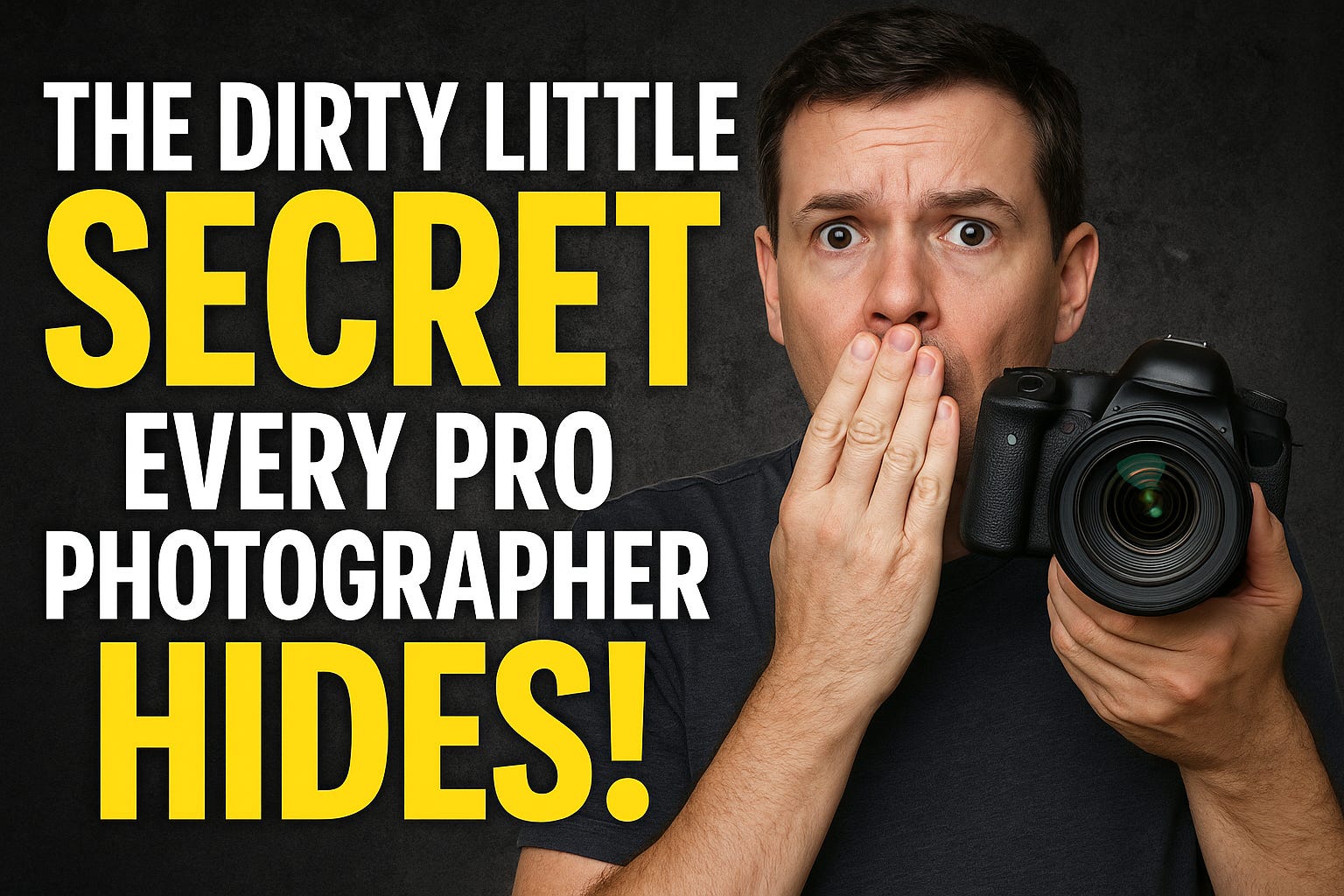
T
his ONE setting will transform your photos! Why 99% of photographers get this WRONG! This pro tip will INSTANTLY improve your photography! The secret the pros don’t want you to know! You’ve seen the titles, you’ve clicked on the thumbnails, you’ve skipped the Squarespace ad-read and 11 minutes later the pay-off is… 11 minutes of your life that you’ll never get back.
The vast majority of people responding to those clickbait titles are hobbyists, recreational shooters, people with an interest in photography as a means of enjoyment – not a pay-day. So my question is this: who cares how the ‘pros’ do it? If I wanted advice on driving my commute, I wouldn’t go asking Lewis bloody Hamilton.
The YouTube Photography Gospel
There’s some awesome photography content on YouTube, but if I’ve learnt one thing since I first discovered it many moons ago, it’s that the most useful videos rarely have the word ‘pro’ in the title.
On the one hand it’s suggesting to the viewer that they’re some unworthy neophyte and that their photography is obviously inferior to that produced by ‘pro’ photographers. And on the other hand it’s suggesting that good photography can be yours if you just do this one thing. Hallelujah, the miracle fix.
So what, my friends, is the source of the ‘pro’ video and who are these self-titled prophets anyway?
Professional What?
It seems to me that, broadly speaking, there are two flavours of “pro” photographer on YouTube.
Firstly, there are those who were working photographers, people who made a living with a camera and who’ve branched out into education and content creation as a side hustle.
And secondly there are those who are first and foremost, professional content creators. They didn’t necessarily build a career in photography itself (they almost certainly came from entirely different fields) but now, with a solid subscriber base and a camera in hand, they wear the “professional photographer” label.
The problem is that the former group create content that has surprisingly little relevance to the amateur/hobbyist people who mainly consume the content. And the latter group use the clout that comes with a big subscriber count to produce content that is designed primarily to get views, not necessarily to educate.
Are there professional photographers on YouTube producing genuinely useful, entertaining content? Absolutely – I follow a heap of them myself. Do they sometimes use the word ‘pro’ in their video titles? Sure, occasionally.
But (and here’s why they’re not always very useful videos) usually, their content is aimed at people who want to go pro too: aspiring professional photographers, not casual hobbyists who just want to learn how to use the curves tool. The type of people using the word ‘pro’ in their titles because they have proper industry experience, usually have solid info for aspiring professionals.
I put it to you that the Venn diagram that describes the common ground between pros and hobbyists is an ellipse so fucking slim that it looks like a papercut. The ‘pro’ way (whether it’s gear, software, or workflow) isn’t arcane wisdom. I’d argue that quite a lot of it is irrelevant to anyone not shooting for ‘the man’.
The Gear That’s Right for a Pro Probably Isn’t Right for a Hobbyist
For a professional photographer their camera equipment is simply a tool that enables them to do their job. It’s not a badge, it’s not a brand, it’s not a flex. They need something that is, first and foremost, reliable. If they’re a press or event photographer, they need camera gear that is rugged, that can survive arduous physical conditions and which can be easily replaced. If they’re a studio photographer they need big sensors, pin-point colour accuracy, tethering and perhaps a modular build so they can easily switch out or upgrade.
There is a diminished aspirational element to the purchasing decision a professional photographer makes when choosing cameras, lenses, flashes, tripods or even SD-cards. Do they aspire to own certain cameras and lenses? Yes, of course, but those aspirations are usually driven by practical considerations, and the brand name on the front (cost issues aside) is interchangeable.
There’s a reason so many non-studio based photographers use Canon cameras. They’re built like tanks, they’re reliable, accessories are readily available, they’re simple and they’re staggeringly unexciting. I used to work for a regional newspaper and the gear cupboard was basically like a fucked up advert for retro Canon hardware.
And while a hobbyist will surely appreciate a camera that is both reliable and rugged—there are a whole different set of criteria that go into their choice of camera brand and camera gear.
I mean, cost for one.
If you’re a professional photographer then spending $15,000 on an f/2.8L Canon EF 400 is in the same territory as a chef spending thousands on Shun blades. Would it be nice to have a $15,000 lens on the front of your camera? Of course. But will a model that costs one quarter of that get you 99% of the way to the same kind of shots? Yes!
Above all, professional gear is not a shortcut for better photographs, no matter what the photography influencers might tell you.
You Probably Don’t Need ‘Pro’ Software
There’s an excellent channel on YouTube that most definitely falls into the ‘actually pro’ category I mentioned earlier.
The bloke in question is the real-deal, a working studio photographer with a long and storied client list, who diversified into making educational videos. He is both sponsored by, and a big supporter of, Capture One. He’s gone on record as stating that it is the ‘best’ photo editor of them all. And this is another one of the problems with the ‘professional’ perspective – it’s usually a highly constrained viewpoint because photographers tend to be specialists.
The afore-mentioned photographer is basing his views on photographic work that takes place in a studio environment where he has absolute and total control over the light. But if you’re a landscape photographer you don’t have the luxury of being able to turn the sun’s power up and down, of having complete control over your environment.
So then, is Capture One still the best choice for photographers not working in a studio? When it comes to something like dynamic range, other applications can pull more stops of light from RAW photographs than Capture One and that’s extremely important for landscape photographers.
An app like Capture One is brutally expensive and it seems unfortunate that a hobbyist photographer, influenced by what the ‘pros’ say, will spend their hard-earned cash on that app, when a cheap or even open source app would do the job just as well, if not better.
In the world of photography the stated views of professionals often filter down and become this half-whispered gospel at all levels. But their criteria often pertain to professional requirements and a one-dimensional viewpoint that has no relevance to most hobbyists.
If you’re a hobbyist that only shoots portraits in a studio environment, then by all means follow his hard-won commercial advice, but if you favour literally any other photographic niche, then seek alternative viewpoints before making any purchasing decisions.
The Enthusiasts
So where does that leave us, the weekend warriors, the 2AM editors, the people photographing fungus or fenceposts for no good reason at all?
It leaves us with freedom. Freedom not to give a toss about ‘industry standard’ software, to embrace workflows that make no bloody sense to anyone but us, to choose a camera because it has one stupidly specific feature we love.
The ‘pro’ culture as presented on YouTube is a trend, one that causes people to obsess about shit that really doesn’t matter.
The ‘pro’ secrets divulged in those videos are nearly always some basic tip (“Keep your ISO low for less noise in your photos!”) and never some illuminati-grade knowledge that the dastardly professional photographers hand down to each other during perfectly-lit blood-letting ceremonies.
And here’s where it gets properly mental – the obsession with pro methods extends way beyond gear and software into every tedious corner of the workflow.
Stressing the Small Stuff
How many videos have you seen extolling the virtues of colour calibration, perfecting your display profile settings, advice about spending thousands on high-end monitors?
That sort of guff might be important if you’re creating a brand-aligned catalogue photo-shoot for a multi-national food and beverage company, but it sure as shit doesn’t matter if you’re uploading to Flickr or sharing the odd print down at the local camera club. It’s like fitness YouTubers flogging elite athlete routines to people who just want to lose their gut.
‘Pro’ workflows are designed for commercial environments where brand consistency is crucial and they need to edit for speed. The average photographer doesn’t need a streamlined editing workflow, they can spend all night on a single bloody shot if they want.
Levelling Up
The whole ‘this is how the pros do it’ bollocks suggests that there’s some linear progression in photography, that begins the day you pick up a camera and culminates in the day you have your passing out ceremony, get handed your Canon 5D Mark III and go ‘pro’.
The inference, of course, being that pros do the best work and therefore that’s what you should seek to attain once you’ve acquired all of the knowledge. But pros don’t actually have to produce good work, they just need to produce work that meets their client’s expectations. Some of the best, most creatively satisfying work is done by people who never monetise it, not by people being paid for it.
The Power of Not Giving a Professional Fuck
So I say bollocks to the ‘pros’—the real ones and the fake-it-till-you-make-it variety.
So-called ‘pro’ knowledge, as presented on YouTube, is just everyday knowledge dressed up with a superiority complex. There’s nothing original about it and there will be no earth-shattering revelations, it’s just the same old advice with a red band lens and a hipster beard.
Ignore the thumbnails, skip the “one weird trick”, and don’t stress about how the pros do it. You’re not them. And honestly, legends? That’s your biggest advantage.
Also published in RAW & Unfiltered on Substack.