When Did Photo Editing Become Everyone Else’s Business?
Your RAW - Your Rules
 Andy Hutchinson
7 min read
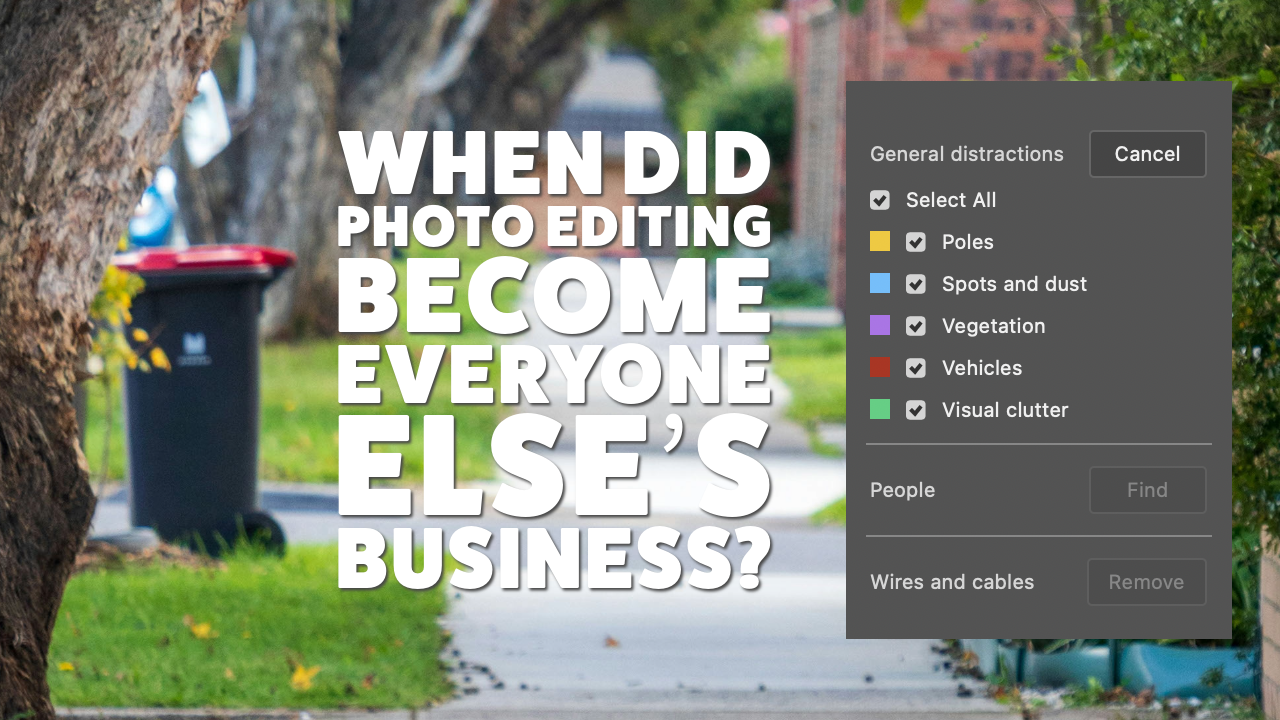
A few months ago I did a video about the general distractions tool in Photoshop, which uses machine learning to identify said distractions and generative imaging to remove them.
I knew when I made it and published it that there would be a percentage of people who would make a broadly negative comment falling within one of these common categories:
Adobe bad.
Subscriptions bad.
AI bad.
You’ve destroyed the integrity of the photograph and I would never sully my own artistic output by doing anything as bourgeois as letting a machine decide what is and isn’t a distraction.
And if I’ve learned one thing over the years I’ve been doing this, it’s that everyone’s got a strong opinion about editing… right up until it’s their photo.
No Tool is Compulsory
My long-suffering wife is a vegetarian and I am an autistic bloke with a beige food palette that hasn’t changed much since I was 11 years old. But on a fairly regular basis I cook for everyone in the Hutchinson household, typically one of about five tried-and-tested favourite meals. And when I’m making one of those meals, I add a few well-chosen spices, in order to enhance the flavour. Some of those meals use three spices, some use six, some use one.
I don’t use every spice every time, and I don’t feel guilty about the ones gathering dust at the back. Nobody walks into the kitchen, sees the turmeric sitting there unused and unloved, and accuses me of being a lesser cook. The key is simply knowing which ingredients and when, in order to have the best outcome.
Or to sum it all up in one simple aphorism: mastery lies in knowing what to leave out.
It’s true of cooking, for sure, but it’s also true of any activity in which you can divert from the ‘recipe’. Editing photographs is no different to cooking. There is no one-size-fits-all solution to post-processing and, like the spices in an evening meal, no tool is compulsory.
Not highlights, not shadows, not curves, not contrast, not AI distraction removal.
But the reason people get so wound up about which tools you use is because they believe there’s a line, and that certain tools cross it.
Isn’t It All Smoke & Mirrors?
Let’s push back the digital photographic process to the very start: the point at which the shutter button is pressed.
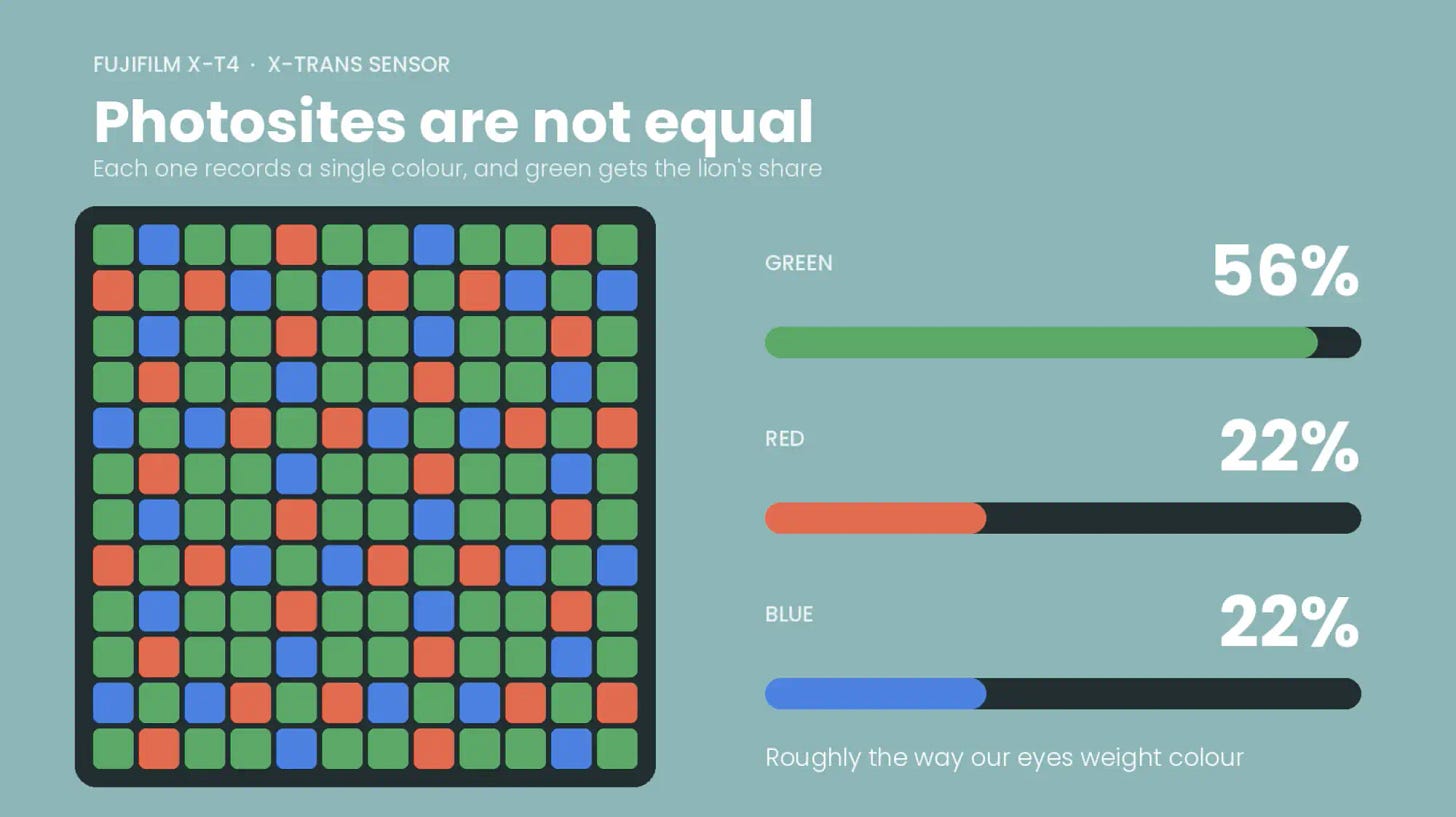
I shoot with a Fujifilm X-T4 which has an X-Trans sensor inside it. And like all sensors it doesn’t record luminance levels and colours for all the tiny photo sites on the sensor; instead it has an averaged array of them. Roughly 56% of the photo sites on that sensor are green, while red and blue get 22% each. This is quite obviously deliberate, designed to mimic the way our eyes receive colour information. The cones inside our eyes have evolved with peak luminance sensitivity in the green part of the spectrum, hence biasing green photo sites on the sensor gives you more perceived sharpness and detail.
And while the science that goes into creating those sensors is incredible, the point at which science and biology meet is never completely predictable. Eyeballs don’t get manufactured on an assembly line, precision engineered; they’re all different for the same reason no two fingerprints are the same. There’s a reason camera manufacturers put that little diopter adjustment dial on the viewfinder: it’s so you can adjust its focus and put your eye against it without needing your glasses. You might even be partially colour blind and have gone your whole life not knowing otherwise.
So, right from the very start, before our photograph even gets anywhere remotely near a RAW editor, we’re all seeing things differently. Every last bloody one of us.
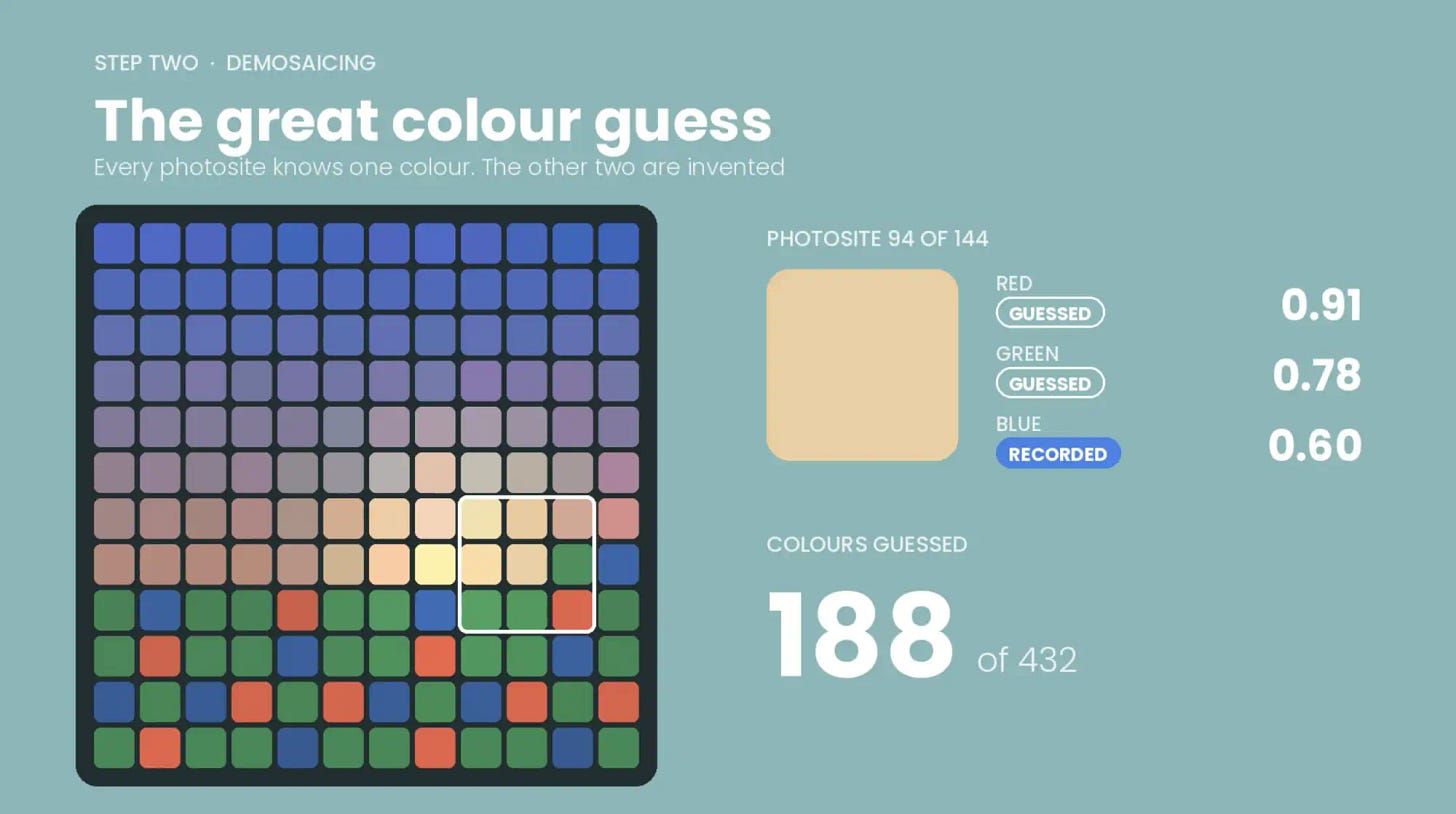
But now a bit of software called a demosaicing algorithm has to do a magic trick, because colour information does not exist for the three primary colours at each little photo site. It’s only one of each: either red or green or blue. And demosaicing is basically a sophisticated guessing engine which tries to decide what the colours adjacent to each red or green or blue photo site are.
So how true is a photograph if an algorithm is guessing colours for us?
Okay, so what if we take RAW off the table and shoot JPEG and ‘straight out of the camera’? No, I don’t think that works either, because A JPEG shooter is just letting the camera’s software make the processing decisions for them. They’ve outsourced the editing to a corporation’s algorithm instead of doing it themselves. It’s actually less accurate than the RAW because not only is there still demosaicing taking place, but now there’s machine generated image processing on top of it.
Well ok then, perhaps I shoot on film? But film types vary in their ability to record specific shades of colour or levels of luminance just like a sensor, and then there’s the way the film is processed and the enlarger used to create prints and the paper that’s exposed to the light from that enlarger.
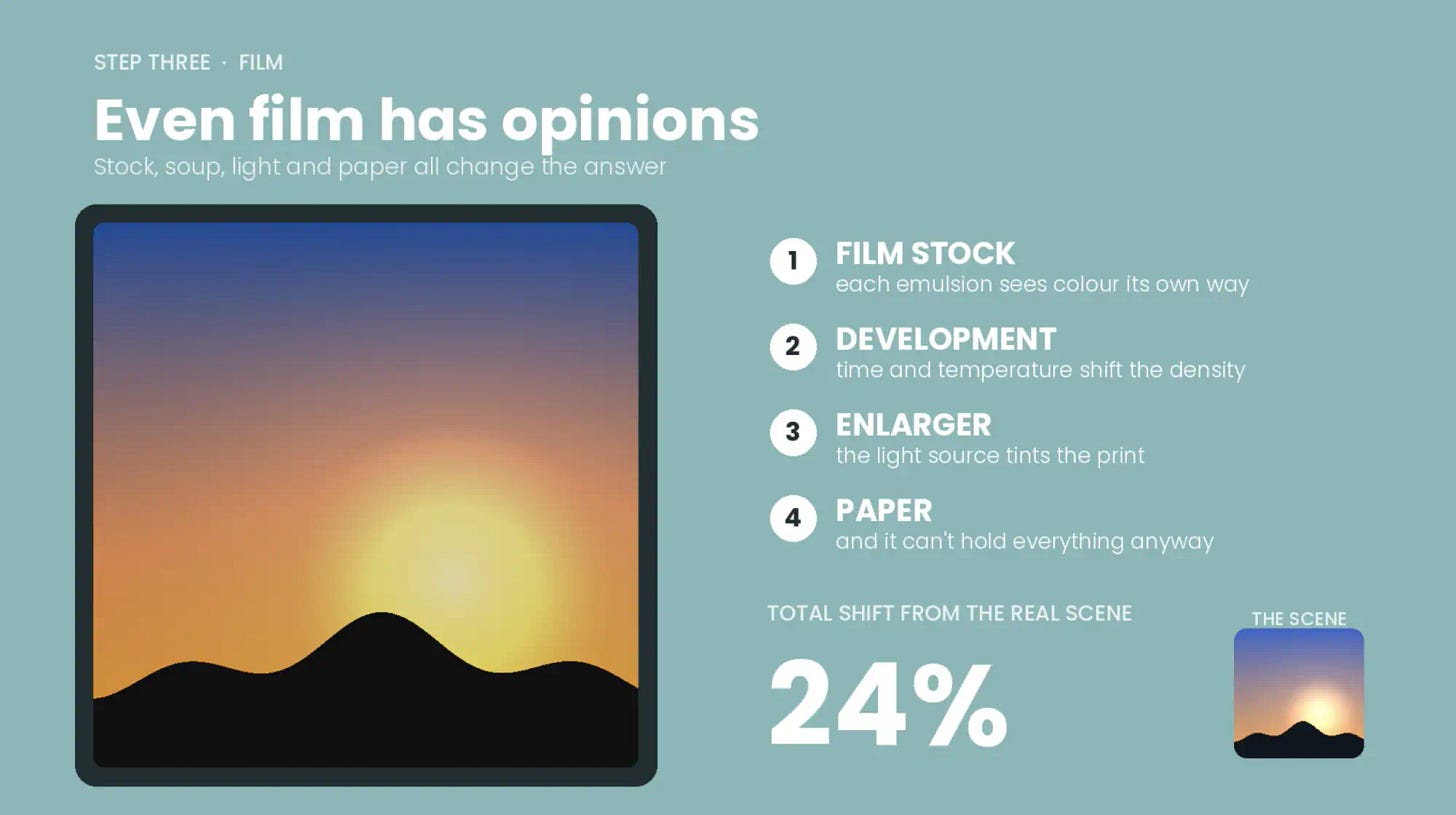
So, I ask you, how is any photographic format, RAW, JPEG or Film, ever a facsimile of a real scene in the first place? Shouldn’t we just stop pretending that there’s some source of truth, a perfect version of a scene captured in all its glory, every detail, every trace, every shade of colour and speck of light?
The camera doesn’t just lie, it was never capable of telling the truth in the first place.
The Truth Index
So a photograph, no matter how it was taken, is only ever an approximation of a scene and we should probably stop being so precious about it.
We talk about the colour science in Leica or Fujifilm cameras, so it’s not like this is some bullet from the blue (an unspoken truth): we all know the cameras are biased. In fact we buy them because of those biases.
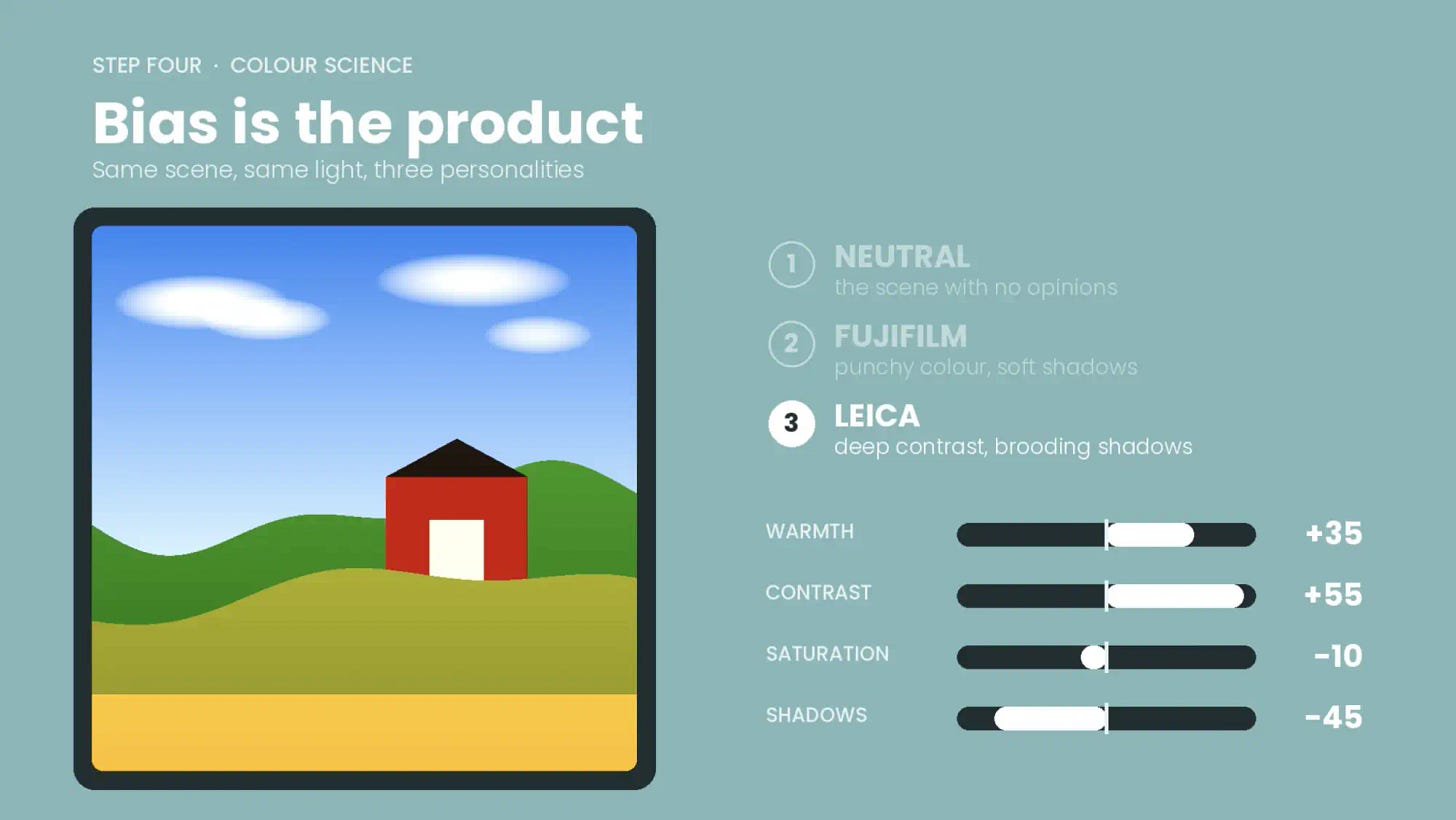
So when it comes to the edit, how do we decide when a photo edit has gone too far and, given that the whole idea of a truthful photograph is a myth, which tools are off the table?
Unless you’re photographing something for news or documentary purposes, then I’d argue that everything is fair game. Photojournalism has ethical codes, sure. But niches like landscape, street and personal work don’t. So if there’s no rulebook for the rest of us, where exactly is this invisible line between acceptable and unacceptable editing?
As far as editing tools go, I haven’t heard many photographers, even the photo-journalists, complaining about the use of the crop tool. But surely deleting a portion of the photograph, for whatever reason, is one of the most dramatic changes you can make to an image?
Even the violently anti-AI crowd are using the crop tool on their photographs: how is deleting part of an image and changing its entire balance more acceptable than removing a traffic cone with a generative removal tool?
You Do You
I would argue that every photograph is a series of choices, and adding or removing a tool from that chain doesn’t change the fundamental nature of what a photograph is, because unless you’re a photo-journalist forced to accept whatever was recorded when you pressed the shutter button, a photograph is whatever you decide it is.
Online you will find thousands upon thousands of videos talking about editing photographs, many of which fundamentally alter the entire look of the image: adding or removing haze, changing the colour grading, using dodge and burn to highlight or diminish specific elements of the shot. And those videos exist because we have the freedom to express ourselves through our photography, not just with the scenes we choose to photograph, but through how we handle the photograph afterwards.
As the photographer, you get to decide what a shot looks like and, if you decide to share that photograph online or to print and sell it, the decisions you made in any edit are utterly irrelevant.
Just as nobody ever looked at a photograph in a gallery, stroked their chin and said, “Pfffft, he should have used f7.1, not f5.6,” equally nobody is going to know that you added some warmth to the highlights or used a generative removal tool to get rid of a rubbish bin you couldn’t frame out of the composition at the time of exposure.
The choices are yours and your alone.
You don’t have to use curve adjustments. You don’t have to use denoise. You don’t have to use masks. You don’t have to use AI.
But if you want to, you can, and absolutely nobody gets to tell you otherwise. No tool is compulsory, but equally no tool is off limits.
It’s your vision. Back yourself.
Also published in RAW & Unfiltered on Substack.