The Real Problem with ‘Free’ Software isn’t the Price
And I'm not talking about open source
 Andy Hutchinson
7 min read
Andy Hutchinson
7 min read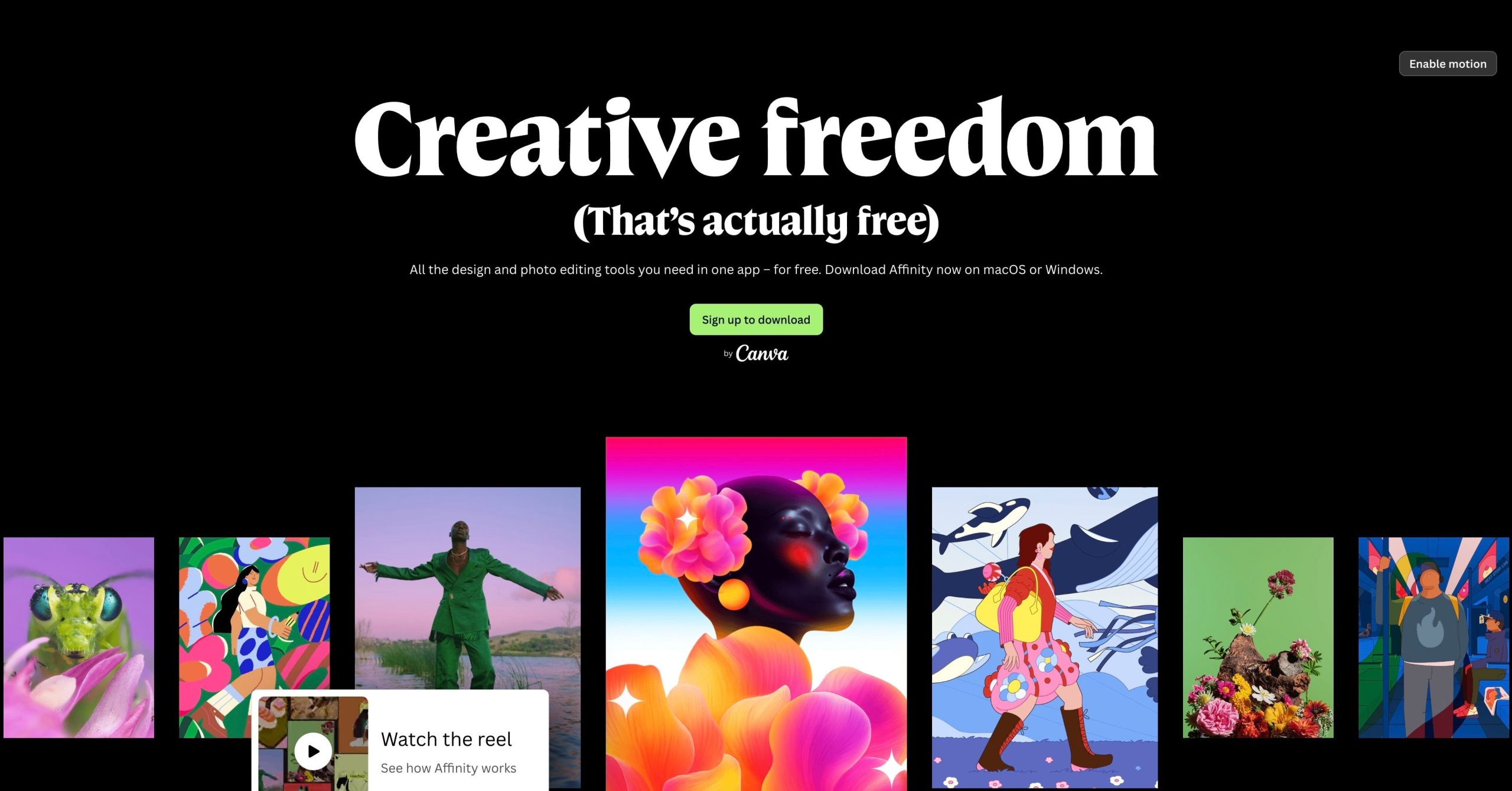
A
t the end of October 2025, Adobe and Canva went toe-to-toe in a keynote competition for the prize of the most toe-curlingly embarrassing tech launch ever. Canva took the prize thanks to a staged phone call section that made even the employee-only audience (shipped in from around Australia and the world) look painfully embarrassed – but it was a close call.
At the Canva keynote, the trio of founders (faces no-doubt aching from forced grimmace-like smiles), announced a range of new services available under the Canva banner. And about two thirds of the way through the hour-long festival of ick – they revealed a brand new app called ‘Affinity’.
Yes, just ‘Affinity’ – one name for what was once three products – Affinity Photo, Affinity Publisher and Affinity Designer. Because, friends, all three of the old Serif apps had been folded into one single entity in order to (according to them) unify workflows, improve speed, and reduce friction.
The app is surprisingly solid for a 1.0 release and the workflow (enabling you to switch between desktop publishing, photo editing and vector tools without needing to save and re-load), is excellent. However the new AI tools bolted onto poor old Affinity (and mercifully available only to subscribers on the premium Canva plans) are mostly fucking awful.
But the biggest reveal of all was that Canva had made this new app free to download and free to use ‘forever’.
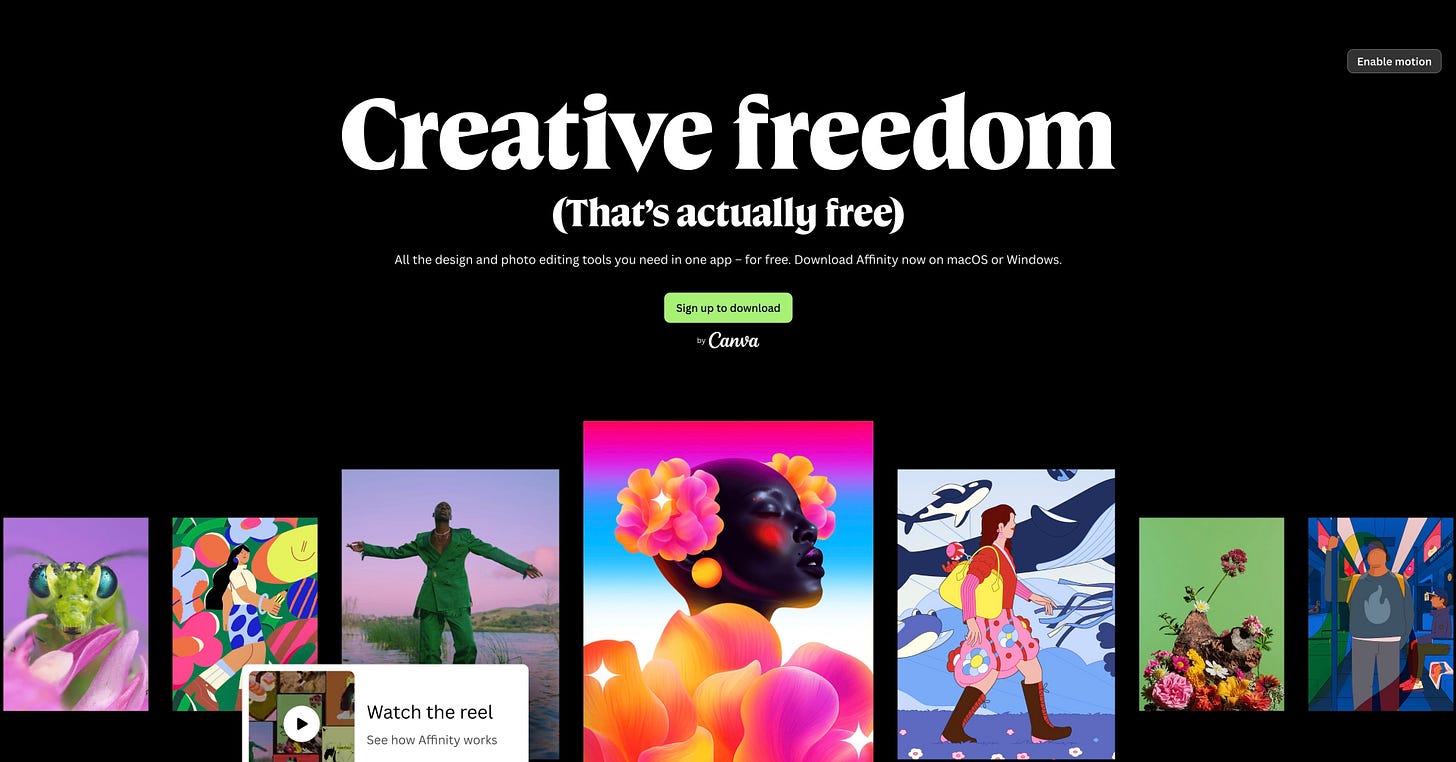
On the face of it this was a noble gesture made by a juggernaut corporation to its loyal customers – an amazing suite of apps merged into a brand-new powerhouse app – let the good times roll.
Never mind the fact that five million Serif customers had paid for these apps (twice in many cases because the 2.0 update fell outside the old ‘perpetual’ definition). Never mind the fact that after Adobe again increased their prices, many people jumped ship and paid for the Serif apps in 2025, keen to escape subscription-hell. Never mind the fact that people bought the individual apps because they had no use for a desktop publishing app or a vector designer.
No, never mind all that because it’s now FREE, as FREE as the wind! Free, I tell you! FREEEEEEEEE!
Free-dom
In 2010, on the old MetaFilter forums, a user by the name of blue_bettle said, “If you are not paying for it, you’re not the customer; you’re the product being sold.” And they were of course, absolutely correct. You don’t pay for these ‘free’ apps and services with an upfront cash price, you pay in other ways that are not always immediately apparent.
And before I continue I would just like to clarify that I’m not talking about open source apps, which are most definitely free in every way, I’m talking about the corporate definition of ‘free’ which is literally just a badge and not a guiding principle.
While everyone was cheering the release of this new single app, I wondered if they realised what had been lost.
The most obvious loss, it seems to me, is any say in the app’s future development. When you get something for nothing you surrender any rights you had to help steer the direction of that app because you are no longer a stakeholder. Serif were a small British company, but they had a loud and supportive user-base who contributed greatly to the development of the old trio of apps. That is long gone.
When an app is faux-free there is no accountability because they owe you nothing. You also give up the right to complain for the same reason. I’ve had heaps of Canva-apologists laying into me for being negative about Affinity in my review of the app for precisely the reason that it is ‘free’. You’re not allowed to criticise it if you got it for nothing.

When an app is faux-free there is far less incentive to improve the app or service. Next year Canva will go public and then the management will have to answer to shareholders who will question the logic of spending money on a freebie when they could be spending development-dollars on the services that paying customers use.
Soylent Green
But, of course, the reason that Canva have released Affinity with no up-front dollar fee is that they will recoup their money many times over by monetising the app’s user-base partly by enforced ‘free’ sign-up at Canva.com whether you intend to use the cloud service or not.
I went through the company’s EULA, privacy, cookie and messaging documents using NotebookLM to cross-reference everything and it’s all there in black and white. Here’s what Canva freely admit to collecting and tracking:
Personal data you provide: name, email, profession, company, phone number when you register or contact support.
Third-party data: information from social logins, linked services, public sources, data providers (job title, employer, industry) aimed at “understanding your profile and interests”.
Automatic device/usage data: browser/OS type, device identifiers, IP address & location (approximate), clickstream/navigation events, analytics event data.
Cookies & tracking technologies: They use cookies, pixels, clear GIFs, mobile device identifiers, and other similar technologies to track you across their website, apps and partner sites.
Advertising/marketing information: They collect and share certain information with third-party ad servers/networks (e.g., email or cookie matches) in order to show personalised ads and measure ad effectiveness.
Sharing/enrichment: They may combine your information with other sources (data providers) to deliver tailored offers or marketing.
It’s impressive stuff. Probably no better than Google or Meta, but still not what I’d call ‘freedom’. It’s all part of a dense and extremely clever adstack of technologies that enables them to monetise you – the user. And while all that information is useful to them, it also gets on-sold. Again – according to their own policies, listed publicly on their website:
They share data with affiliates, service providers, ad networks and social platforms for advertising & marketing (“serve personalised advertisements … on our Service and other sites”).
They may share your email, location, cookie info and usage to allow matching against data from ad partners / networks for retargeting.
They also collect aggregated/anonymised data for analytics, product improvement, but also for marketing segmentation and identifying “potential new users” through look-alike modelling.
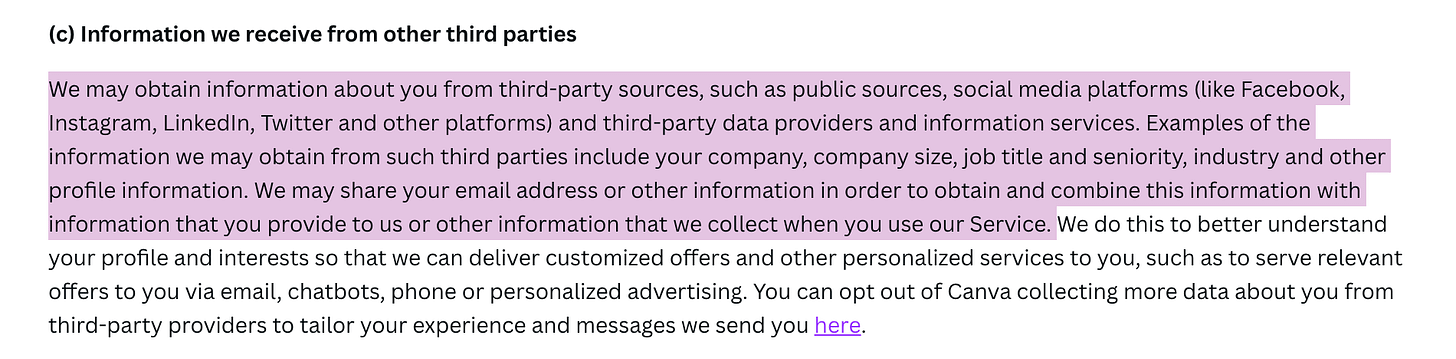
You have to admire the complexity of it all. Canva’s cookie settings are structured so the stuff that’s most valuable to them (security data, session identifiers, infra vendors) is non-rejectable, while the obviously-advertising stuff is in the ‘Targeting’ bucket you can turn off. It’s consent-shaped, not consent-driven.
Upsell Hell
So, leaving aside the staggeringly sophisticated level of surveillance you agree to when you sign up with Canva in order to use the Affinity app, there are of course other motives at play behind the ‘free’ release.
First-time users of the app might have noticed the big ‘Canva AI’ button on the main toolbar. This houses a suite of AI tools that are only available to paying subscribers on the Canva premium plans. And, again, the apologists will tell you that you can turn that button off – out of sight, out of mind – and never have to think about the paid-for AI tools again. Except that there are little premium icons 👑 scattered throughout the menus that will remind you every single time you use the app that there are tools and services that are not available to you, you cheap bastard.
The AI tools in Affinity are among the worst I’ve ever used – third-rate, slow and singularly useless. But it’s AI-with-everything in the post GPT-era and Canva (being a highly successful corporation) are fully aware of that. And who knows, they might even improve those AI tools to the point where they’re as mediocre as Adobe’s, and then more people who downloaded the ‘free forever’ Affinity will sign up for a premium plan in order to use them.
It should, by now, by brutally obvious that Affinity is free only because it serves as a first-rate sales funnel for the wider Canva services. As they build out the app, new features are unlikely to be added to the ‘free’ component of the app, but stuck behind the same paywall as the current sub-standard AI tools.
The app is a trojan horse – a gateway to the broader Canva ecosystem. Switch over, start using the .af files and then you’ll find yourself just as stuck as many current users feel within the Adobe ecosystem.
Weyland Yutani
In Canva, there’s something of the reality-distortion-field that Apple was famous for in the Steve Jobs days, or the early Tesla days, when there’s an almost messianic cult-like fervour to the proclamations made by the true believers.
I’ve seen some impressive hot-takes in the comments section of my recent uploads to YouTube, but I was struck by the cult-like responses from some regarding Canva. They seem to be labouring under the delusion that this $65bn company is ‘better’ than other global corporations like Adobe.
They point out the founders philanthropy, as if that somehow excuses the industrial-scale data harvesting that contributed to their billionaire status. It’s still a corporation, not a charity.
Canva throw around the word ‘free’ like Amazon do with the word ‘deal’ because in both cases, the real product isn’t what’s in the cart – it’s you.
Also published in RAW & Unfiltered on Substack.