Fuck Unsplash
Photos for Nothing: The Unsplash Scam and How Photographers Lost Their Way
 Andy Hutchinson
15 min read
Andy Hutchinson
15 min read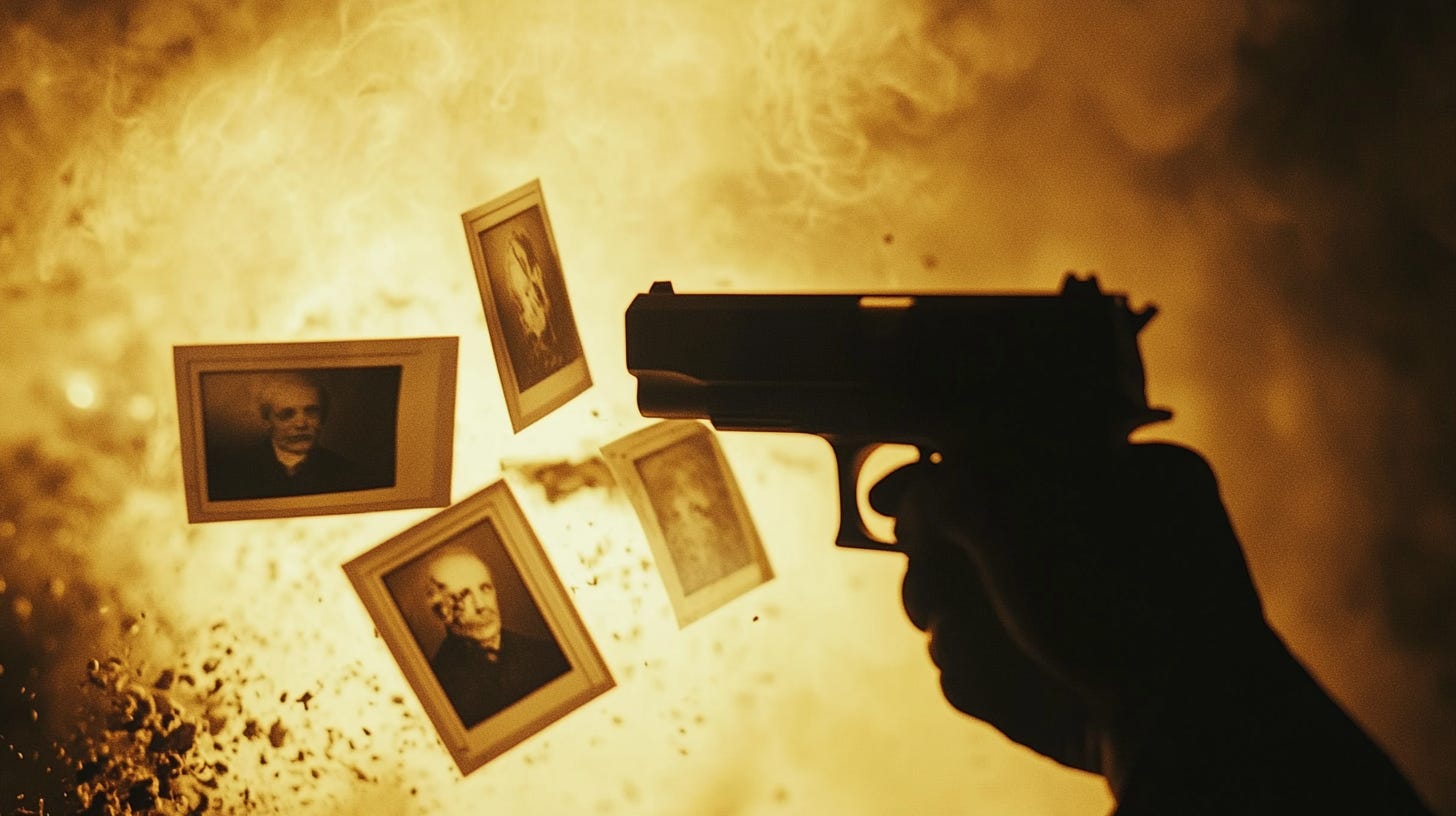
Note: this article was originally published on my blog in 2021 and has been updated as I transition my work over here to Substack.
W
hat I’m about to tell you, may come as a shock, but hear me out.
There was, believe it or not, a brief period in the late 1990s and early 2000s when it was possible to make a living from digital stock photography. It might sound like bullshit, but it’s true – regular photographers used to be able to pay the bills by licensing their images to stock libraries. Even if you weren’t getting rich off stock photography, it was a nice little side-hustle for many photographers, bringing in a few welcome residual payments to compensate for the lean periods associated with any creative job. The craft of being a photographer was valued and consequently, people were willing to pay money for photographs.
Unfortunately those days are long gone and, unless you operate a stock photo business on an industrial scale, as some folks admittedly do, you cannot get even close to breaking-even in stock photography. It’s a mug’s game, a scam and a glorified pyramid scheme.
When you factor in all the hours that you’ve sunk into learning the craft of photography and all the money you’ve spent on equipment and all the further time you spend taking and editing your photographs, you will never get close to being reimbursed for the investment you made in time, effort and money. That is a cold hard fact.
As desolate as the stock photography scene is however, in this article I wanted to talk about the pre-eminent anti-stock photography website – Unsplash – and why I think that it’s a sucking black hole in the middle of the photography scene. I think Unsplash is unremittingly awful and I think you should have absolutely nothing to do with it.
Now before I get into the negatives and the negatives of Unsplash, let’s cover a bit of the back-story and more specifically why we photographers are getting so royally screwed. And as I see it, there are two reasons – the first reason is middle-men and the second reason is self-belief.
The Middle-Men
In the world of commercial photography, the middle-men are the stock libraries. They serve as a conduit between the photographer and the client that wants to use their image. They hook them up with each other and in return they take a percentage. Their U.S.P. is that they can put your photograph in front of people who want to use it commercially and whom you’d ordinarily have trouble connecting with.
In the modern era, stock libraries are international conglomerates that hoover up photography from all over the world, package it up, stack it high and sell it cheap. These businesses have slowly but surely turned stock photography into a zero sum game. Getty, Shutterstock, Dreamstime and Adobe – to name but four – sign up photographers, plunder their photographic portfolios and reward them with chump change in return for their graft and creative skills.
There are strong parallels here between several industries, but one that springs to mind here in Australia is milk. Thanks partly to the processors that sell milk onwards to stores and thanks partly to the supermarket chains, the price of a litre of milk has been pushed further and further down. It has reached the point now where farmers are barely able to break even and incredibly, milk is now cheaper than water.
This same process has occurred in hundreds of industries in all of the countries of the world and photography is no different. The situation has been woeful for a long time now, but it got really bad when the large stock libraries introduced subscription packages that offered subscribers cut-price access to photographs in return for agreeing to pay a fee every month.

The stock libraries loved this system as they got regular payments every month whether the photographs were being licensed or not. It’s exactly like the business models employed by most modern gym chains – they count on the fact that a high percentage of people will not use their facilities very often, if at all.
Photographers got royally fucked by subscription stock packages because they didn’t see any portion of those monthly payments unless someone actually licensed their photo. And even if, by some remote chance, someone did licence their photo through a subscription package, the photographer’s payment, their percentage of the customer’s monthly subscription fee – is a tiny amount – usually less than a dollar.
It’s like some kinky master/slave relationship where the master (the stock library) repeatedly punches the slave (the photographer) in the throat and they keep coming back for more.
So subscription-based packages from stock libraries are an unmitigated disaster for photographers, but let’s be honest here, it’s only marginally better outside the subscription system. For the amount of time and effort required to take a photo, the photographer will earn only a few bucks in chump change (at best) for their efforts.
In order to earn anything close to approaching a decent residual income of, let’s say $2000 a month – you’d have to upload tens of thousands, probably hundreds of thousands of images to the stock library. Each of which would of course have to be titled, categorised and keyworded. You’d also have to make sure your images remained topical in order to ensure that anyone searching the billions of images in those libraries wanted your images in the first place.
Okay – so I think I’ve established that stock photo libraries are a disaster and that no photographer should have anything whatsoever to do with them, what does Unsplash have to do with all this?
It’s simple – Unsplash is the natural end-point for stock photography, the last-chance saloon, the logical and inevitable conclusion to the endless reduction in royalties. You see, in order to compete with the existing stock libraries, the founders of Unsplash came up with a brilliant idea – instead of reimbursing photographers for their efforts – pay them nothing.
Nada. Zilch.
The genius of Unsplash was that it made giving away photos feel like a virtuous act. In fact, if you got bamboozled by their nuclear-grade bullshit and jumped on their hype train they made you feel like they were almost doing you a favour, taking your photographs off your hands for nothing.
There have always been public domain photo libraries, but Unsplash tried (and partially succeeded) in making giving away your photographs for nothing feel good. They industrialised the public domain photo library scene.
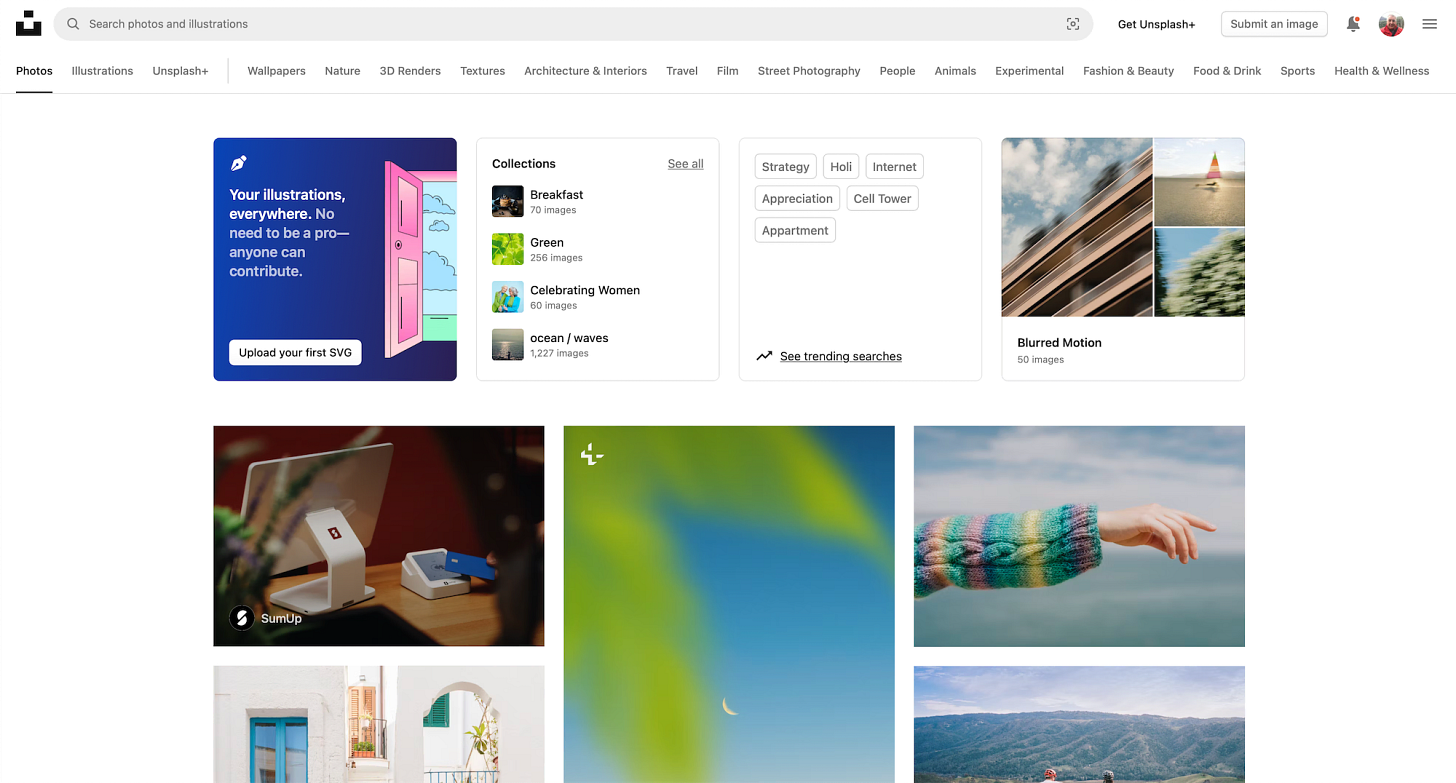
In 2013, when the founders of Unsplash began their campaign against commercial stock photography, they branded themselves as a force for good. And the really hilarious thing is that they got away with it. There were even Unsplash events in which photographers who had given away their photographs for nothing met up with other photographers who’d given their photographs away for nothing and they patted each other on the back for giving their photographs away for nothing.
Pretty soon businesses started paying attention to Unsplash and began leveraging the massive library of images as value-adds for their own products. So Medium ‘partnered’ with Unsplash to make the library available right within their system. Apple jumped onboard pretty early in the piece too, then Trello, Weebly, Squarespace and countless others. And why wouldn’t they? There was no down-side for those companies, it was the gift that kept on giving. Everyone did well out of it except for … you’ve guessed it … the photographers.
The level of bat-shit crazy marketing bullshit that Unsplash unleashed in order to market their site was quasi-religious.
In 2018 Unsplash were celebrating an investment of $7million (that their photographic contributors would never see so much as a cent of) and they said this:
“The Unsplash ecosystem is pushing the impact of photography further than ever before. Our aim is to make photography a universally accessible art form. The purpose of raising this investment is to build a new type of economic future for photography when it is set free.”
What. The. Actual. Fuck? “A new type of economic future for photography when it is set free.” How is it an economic future if it’s free, you drop-kicks?
It might have been an ‘economic future’ for you and the rest of the Unsplash crew, but not so much for the millions of folks who put you there. And also what part of the art-form of photography wasn’t universally accessible before? It’s the most successful art-form on the planet!
Of course that $7million investment was a small drop in the ocean compared to what came next. And this was always the likely outcome that the founders of Unsplash had been working for.
The champions of public domain photography sold their company to the biggest stock photography business on planet earth – Getty Images.
Yes, Getty, the company that devours all stock libraries standing in its way and who previously acquired (and completely ruined) other notable companies like 500px and iStockPhoto, decided to spend cold hard cash on a service that gives photos away for nothing. If this isn’t proof that Unsplash is just one massive racket, then I don’t know what is. Getty are a phenomenally successful company and they knew full well that there was money to be made on the backs of photographers who naively gave their creative work away for nothing.
My UnSplash Experiment
Now over the years I heard a lot of crap about Unsplash and one of the popular marketing messages they put out was that giving away your photos could open the door to commercial work. By putting your work out there for nothing, you would attract businesses to your brand and they would actually pay you to work for them. And so in 2018 I decided to put this to the test with a little experiment of my own.
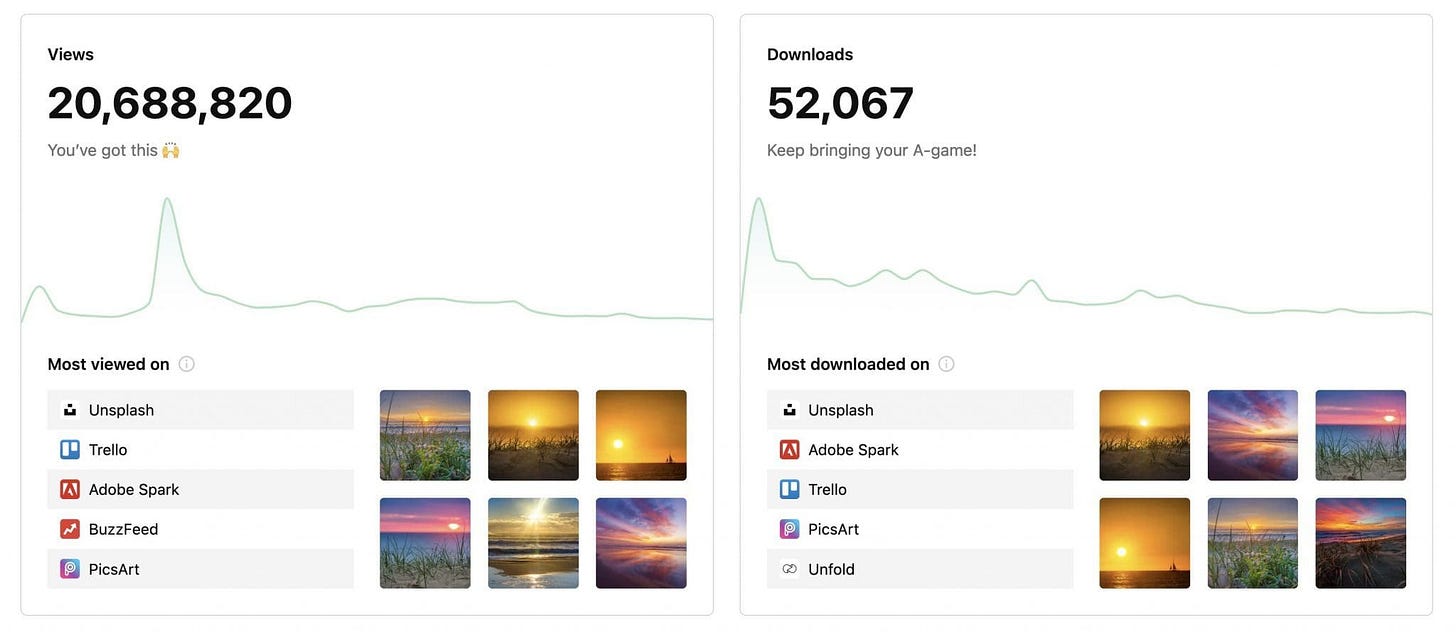
I picked out 18 photographs from my own library of nearly a quarter of a million shots and I uploaded them to Unsplash. Yes, that’s right, I decided to sacrifice some of my photographs so I could test the marketing spin.
My photographs turned out to be pretty popular and over the years they have been viewed and downloaded millions of times. I decided to leave my 18 sacrificial photos there as part of an on-going experiment and every once in a while Unsplash email me to tell me just how much everyone except me is benefiting from my photographs.
Over the years my photographs accumulated over 30 million views. Nearly 75,000 downloads. They were used on sites like Buzzfeed, Medium, Trello and Notion. My most popular photograph was been downloaded an incredible 25,000 times before I called a belated halt to the experiment.
And can you guess what I got in return for all those views and downloads? That’s right – sweet fuck all. Nothing. Nada. No business inquiries, no ‘exposure’, no collaborations. Zero. Not so much as a reach-around.
Now evidently my photographs have commercial appeal. How can anyone argue to the contrary when they have been used over 60,000 times? It is a statement of fact. And yet I’m still waiting on all these business opportunities to flood my inbox. Actually that’s a lie – I’m not waiting. I was under no delusions when I uploaded my 18 photos to Unsplash. I knew that there would be absolutely no benefit to me and I have been proved 100% right.
But hold on Andy, I hear you cry, don’t forget that this is all about the greater-good, mate. You’re helping to, and I quote “fuel creativity around the world”. And I’ll tell you what, I’m all down for the greater-good if we’re all getting nothing but a warm glow of contentment out of it, but that simply isn’t the case, is it?
This is some Animal Farm version of the greater-good – all pigs are equal, but some pigs are more equal than others. If Unsplash was all about ‘community’ and ‘creativity’ then surely the founders of the company would have ploughed those Getty dollars back into the community, right? Or does being selfless only extend as far as the schmucks uploading the images?
The founder and CEO of Unsplash was Mikael Cho and I had a poke around on the Internet looking for photographs of his house. Unfortunately I didn’t find any but I’m willing to bet he’s not living in a five square metre apartment, washing his socks and jocks in the kitchen sink and living on two minute noodles.
Let’s be clear about this. All that Unsplash has achieved in its glorious 12 year history is the suicidal devaluation of the already chronically devalued stock photography market. It’s hard to go past free.
But hold on, you might be saying, what about the quality issue – you can’t compare the professionally produced images on iStock with the amateurish snaps available on Unsplash? And there’s two answers to that – firstly much of the photography on Unsplash is great and secondly, even if they were ‘worse’ – it doesn’t matter.
They don’t have to be as good as the photos on Adobe Stock or Dreamstime or Shutterstock, because they’re perfectly acceptable for the majority of the use-case scenarios in which a stock photograph is required. They don’t have to be amazing – they just have to be good enough. Despite what the marketing team in the Emperor’s New Clothes department of Unsplash might suggest, they are not being used for the covers of magazines, they’re the headers to a million blog articles on fishing tackle, crafting and Funko collectibles. There’s millions of images on Unsplash now and you can find a half-decent image for pretty much everything you require.
Unsplash’s death-blow to the casual stock photography scene isn’t actually what annoyed me most though. Getty and the other stock libraries had, as I’ve already shown, made their royalty payments to photographers so minuscule that it hasn’t been a worthwhile enterprise for many years now.
No, what annoys me most is how Unsplash made millions of dollars in profit out of the goodwill of the photographic community. People freely gave up their images because of some bullshit feel-good fantasy and they got repaid by the company founders selling out to Getty who plastered iStockPhoto adverts all over the site. Getty turned Unsplash into one big upsell. Can’t find what you’re looking for, madam? Perhaps it’s available in our iStock collection? Allow me to show you a selection of possible images.
If you’ve ever considered uploading your photographs to Unsplash, please don’t. And if you’ve ever uploaded photos there, consider deleting them. By continuing to share your images freely on Unsplash you are making money for the biggest commercial stock photo company on the planet. There are men in expensive suits sitting in meeting rooms in flashy offices belly laughing at Unsplash’s contributors, incredulous that people could be so naive.
We will never return to the days when it was possible to buy a new lens for your camera from the residuals accumulated by your photographs licensed to a stock library, but we can at least retain a little bit of our dignity. In particular, raise a middle finger, point it squarely at Unsplash and have nothing further to do with them.
The supreme irony in all this is that generative AI might be the only silver lining in this grim tale. While photographers were getting royally shafted, the same tech giants who profited from devaluing their work found themselves facing a similar existential threat. Getty’s business model – built on exploiting photographers and gouging clients – is now under siege from AI image generators that can instantly create passable stock photos from text prompts. Their billion-dollar image library suddenly looks as relevant as a fax machine at a TikTok convention. After years of pushing photographers’ fees into the toilet, Getty now finds itself howling with indignation at AI companies “stealing” their images for training data.
There’s a certain poetic justice in watching the ultimate middleman scramble to prove its relevance in a world where even mediocre stock imagery can be conjured from thin air with a few keystrokes.
Self Belief
Now I’m aware that this has been a pretty negative article and as I’m actually a naturally optimistic sort of a bloke, I wanted to finish things off with a positive suggestion. Earlier on I mentioned that the reason photography had become so devalued was due to middle-men and self-belief and it’s that second part I wanted to talk about now. You see I feel that if photographers had better self-belief and valued their own work more highly, we wouldn’t be in this situation in the first place. After all, nobody holds a gun to your head and forces you to upload your photos to a stock library or indeed to Unsplash – it’s a conscious decision that people make.
We feel like we need these middle-men to successfully market and to sell our photographs and the truth is that in many cases – we simply do not. It is possible to make money from licensing your photographs if you take ownership of the entire process.
I stopped uploading my images to stock libraries 14 years ago and began selling them myself and let me tell you guys, if I can do it, then anyone can. I licence my photos to local businesses, tourism organisations and the media. I can do this, because I have a little niche. I sell landscape photographs of a very specific part of the world – a small region known as the south coast of NSW. And while I might be tempting fate, there is not that much in the way of organised competition out there also selling photographs of this part of the world.
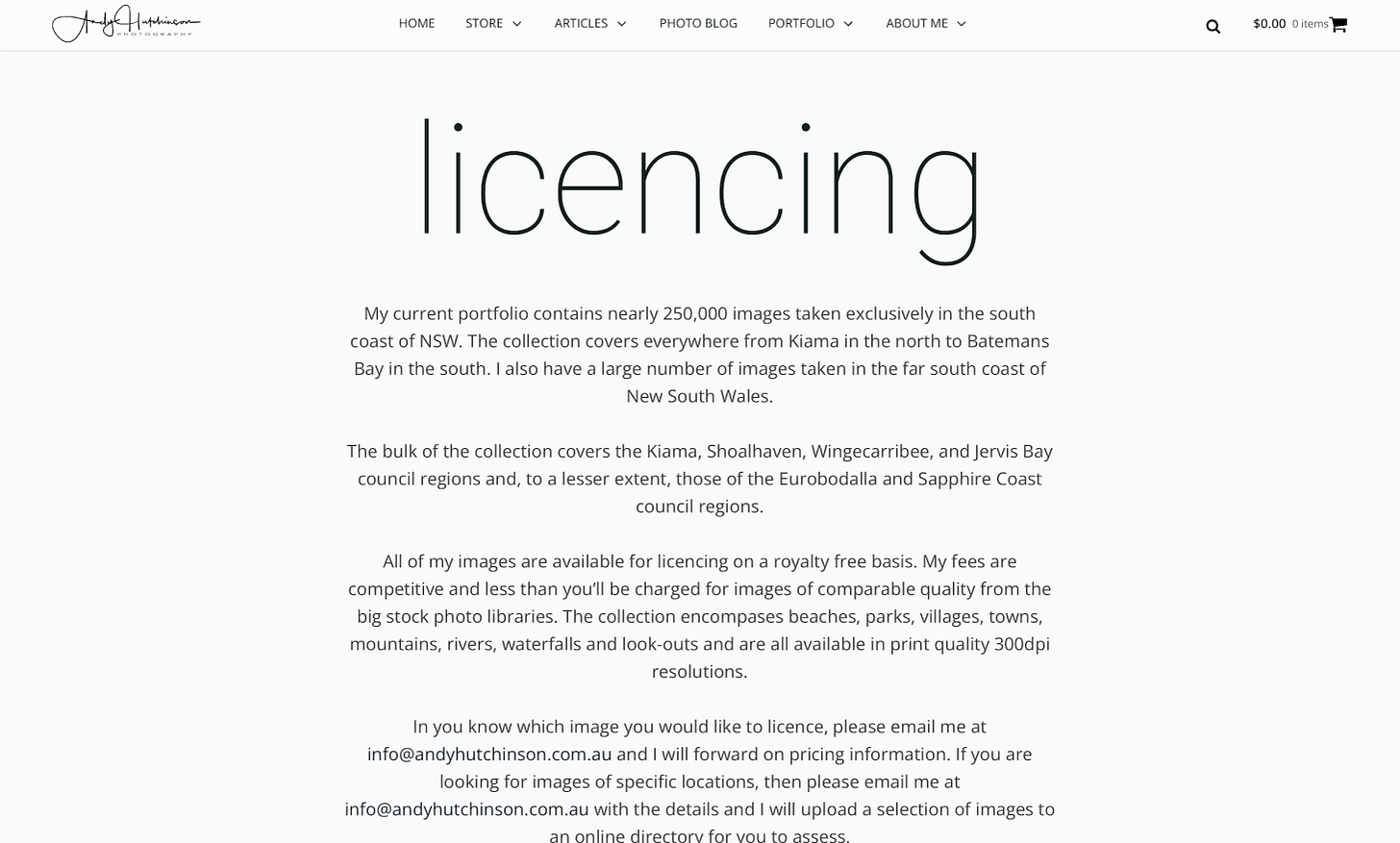
I’ve got nearly 250,000 photographs of the south coast that I’ve shot over the last decade and there isn’t a stock library on the planet that gets within a nautical mile of that. Not Getty or its myriad subsidiaries, not Dreamstime, not Shutterstock, not Adobe. I’ve been through those libraries looking for photographs of this region and the options are limited and, for the most part, pretty crappy. For many well known locations here, the stock libraries don’t even have a single image to licence. And you also find the same crappy images in popping up wherever you look, because the photographer’s uploaded them to multiple libraries to improve their chances of a sale.
So when someone wants a photograph of a local beach, town, park or look-out – and when they don’t find what they want on the afore-mentioned stock libraries – I’m often the one they call. And when I licence my photo, I get the full and complete fee and I’m still usually cheaper than the stock libraries and a lot easier to deal with.
So if you’ve got a niche, perhaps a specific geographic region you live in, or even a style of photography that you’re adept at, then I strongly suggest you take advantage of it.
Leverage the uniqueness of your niche. Don’t upload to the multi-national stock libraries and, for fuck’s sake, do not upload to Unsplash.
As long as we photographers let these organisations take the piss out of us – they will continue to do so. Stand up for yourself, take control of your portfolio and give the middle-finger to the middle-men.
Also published in RAW & Unfiltered on Substack.