The Power of Being Happy with What You’ve Got
When upgrading doesn't help any more ...
U
nless you’re living in North Korea, work permanently at McMurdo station in Antarctica or belong to an uncontacted tribe in the Amazon delta – and I’m going to go out on a limb here and suggest that none of my viewers are – you almost certainly live in a society driven entirely by product.
As we first emerge new-born, blinking and screaming into the world we are catalogued, indexed and profiled and the selling begins.
From the cradle to the grave we are subject to a global marketing machine whose sole purpose is to influence us into buying ‘stuff’.
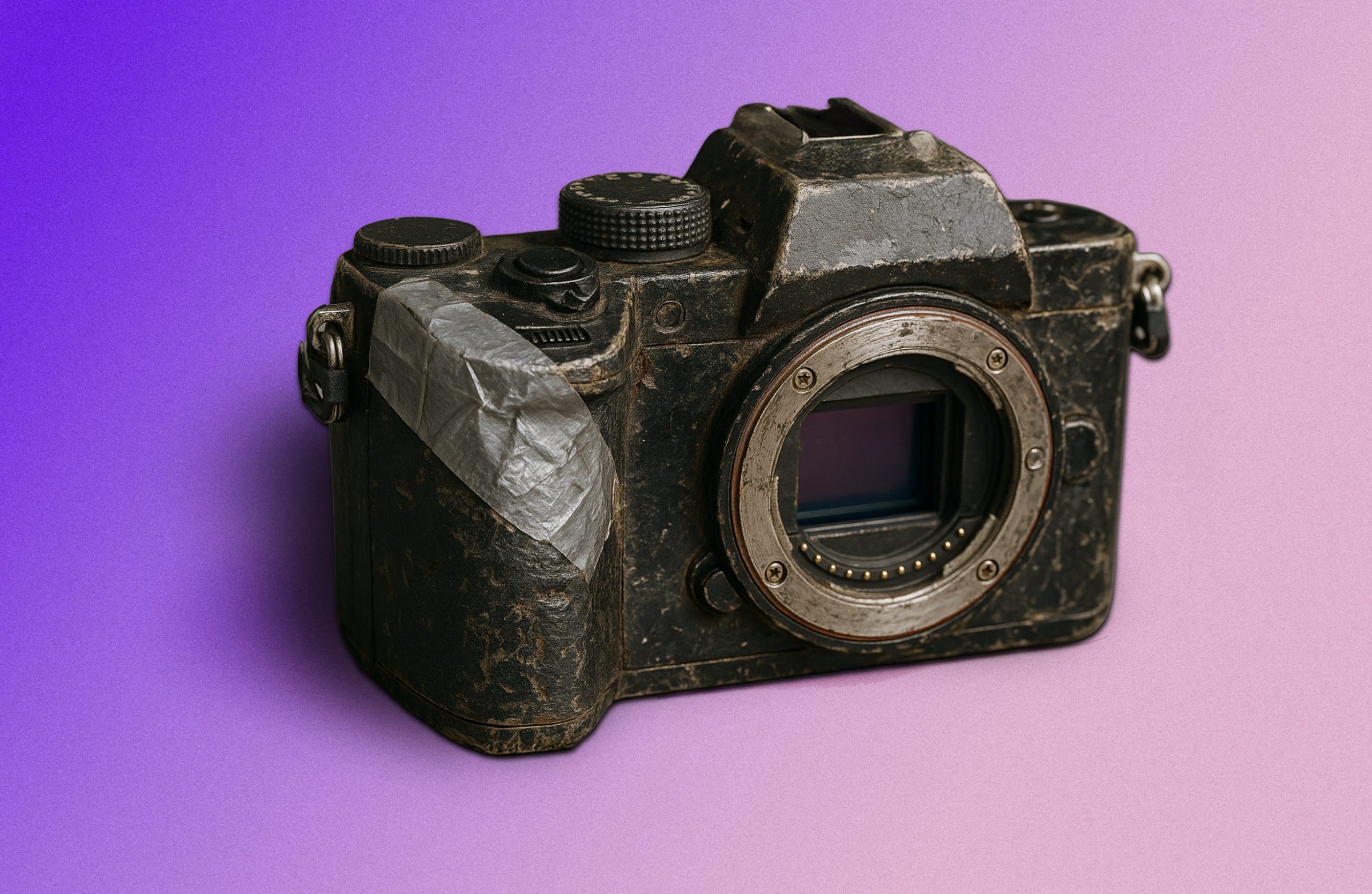
Photographers are uniquely afflicted by GAS – Gear Acquisition Syndrome — a chronic condition where fulfilment is always just one camera body, lens, tripod or camera bag out of reach. But GAS is an infinite loop. There’s always a newer, shinier, slightly better bit of kit promising to solve all your problems.
So there’s two options. You can either carry on filling your life with stuff in the vain hope that it’ll make your photography better and your life more meaningful. Or you can do what I’m trying – stop doom scrolling B&H Photo, start shooting, and get on with using what’s already in the bag.
As Sir Michael Philip Jagger once said, “You can’t always get what you want, but if you try sometimes, well, you might just find that you get what you need.”
Yes, I said I’m trying. Didn’t say I was perfect – what’s the saying – progress, not perfection. I figure you need to give yourself permission to fall off the wagon occasionally, so long as you jog along the road to catch up with it afterwards.
But I have, all-be-it quite late in life, arrived at a point where the accumulation of new and possibly better stuff is no longer such a driving force in my life. Yes, it happened quite late for me. I was always envious of people who could resist the marketing, the impulse to spend, and just tick over for years and years with the same gear.
One of the biggest turning points for me, was when was I purchased my DJI Mavic 2 Pro in the before-times of 2018. You remember 2018 – TikTok was barely a thing, Instagram still showed posts chronologically, AI was still in the lab, working from home raised corporate eyebrows and Corona Virus was the hangover you got from drinking too many Mexican beers.
The Mavic 2 Pro remains a high watermark in DJI’s back catalogue. It has a Hasselblad 20megapixel 1” sensor, adjustable aperture and 10-bit D-log video at 100Mbps. It has nearly 30 minutes of flight time out of a battery, 10km transmission range with Ocusync 2.0 and was the first drone to get an automated hyper-lapse mode.
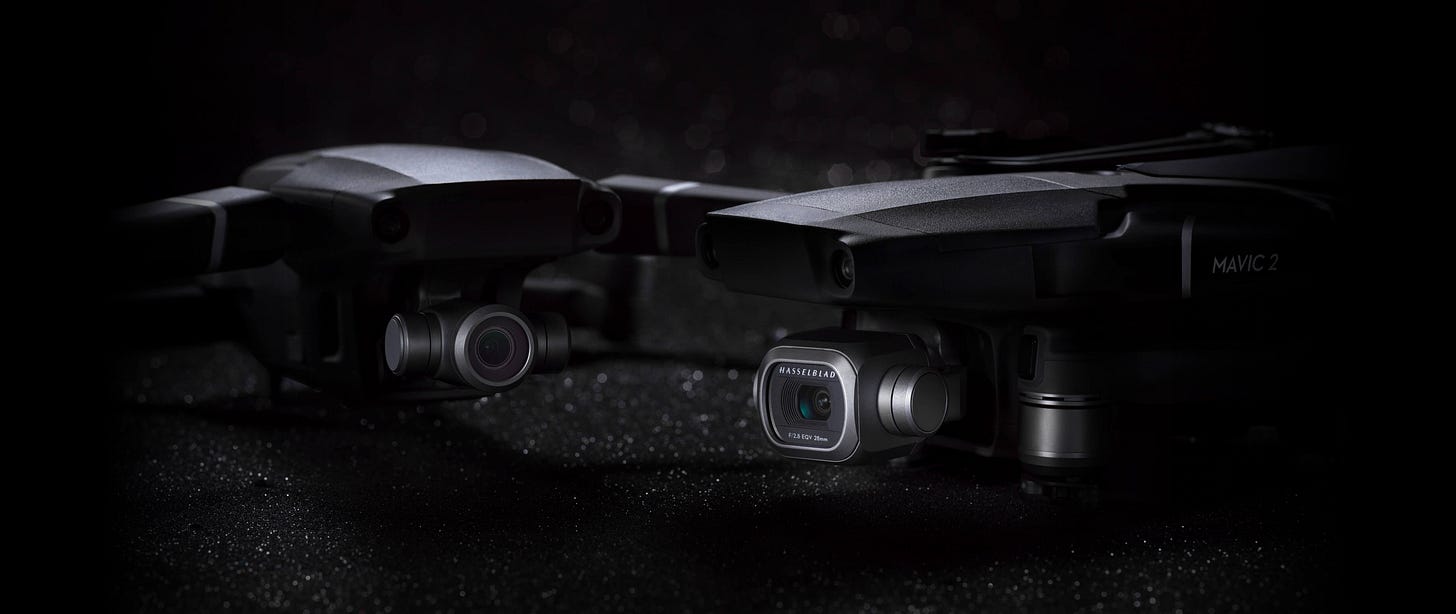
I’ve watched as DJI have rolled out the Air 2, Air 2S, Air 3, Air 3S, Mavic 3, Mavic 3 Classic, Mavic 3 Pro, Pro Cine and Mavic 4 Pro. And as awesome as those subsequent mid-sized drones undoubtedly are, not once have I been tempted to upgrade my Mavic 2 Pro.
The sensors are very slightly bigger, the dynamic range is very slightly better, the flight time is very slightly more. But it’s only really the lenses that have changed with any degree of practical real-world significance.
The Mavic 2 Pro was the turning point I needed to get off the conveyor belt and remember that DJI weren’t going to release a drone that’d shot my videos for me.
Cost
There are of course many reasons to be happy with what you’ve got, but cost is surely one of the most important ones.
Unless you’re a fully paid up member of the ‘comfortably-off’ club, you’ve got to be feeling the pinch, economically speaking. There isn’t a country on earth where everyday people aren’t doing it a lot tougher than they were a few decades ago. And not upgrading camera gear has got to be one of the easiest ways of saving a few bucks for the more pressing concerns in life.
A good place to start is having a firm word with that little voice, the ‘shiny new things’ voice, that sprints centre stage every time a new bauble twinkles in the peripheral vision. My old mum’s voice pops into my subconscious when I feel the urge to ‘Add to Cart’. When I was a child and I pointed at some new thing she’d say, “Is the old one broke, Andrew?” And that was the end of that.
Marketing
But at the same time, we need to cut ourselves some slack because this impulse to constantly ‘upgrade’ is not completely our fault – we’re betting against the house – and the house always wins. We’re playing with a loaded deck and very poor odds because there’s a massive global marketing machine working on us every second we’re awake and if you’re a bona fide dreamer, probably in your sleep too.
It’s not as simple as seeing an advert for something, it goes far beyond that, it’s the carefully constructed lies that make our perfectly good gear feel inadequate.
One whole extra stop of light, f1.8 instead of f2, an amazing new nano coating, a flip-out screen, fluid drag control, dual slots, RFID-screening pockets.
It’s the drip, drip, drip, like water on stone, rather than the flashy launch videos that usually tip us over into the credit card danger zone.
The Hype Machine
The urge to abandon our perfectly good equipment and move on to pastures new is fed by a whole range of external traps just waiting to ensnare us. Societal, marketing and peer-driven forces are always there, waiting to lead us astray.
The upgrade trap is a famous one because it promises us a better experience, a fuller feature-set, improved performance and, of course, most importantly – ‘better’ photographs. But as we all learn pretty quickly, chasing the next big thing rarely leads to better photos or satisfaction. Honestly it often has the opposite effect because we suddenly feel like suckers for thinking a few more megapixels on a sensor will transform our photography.
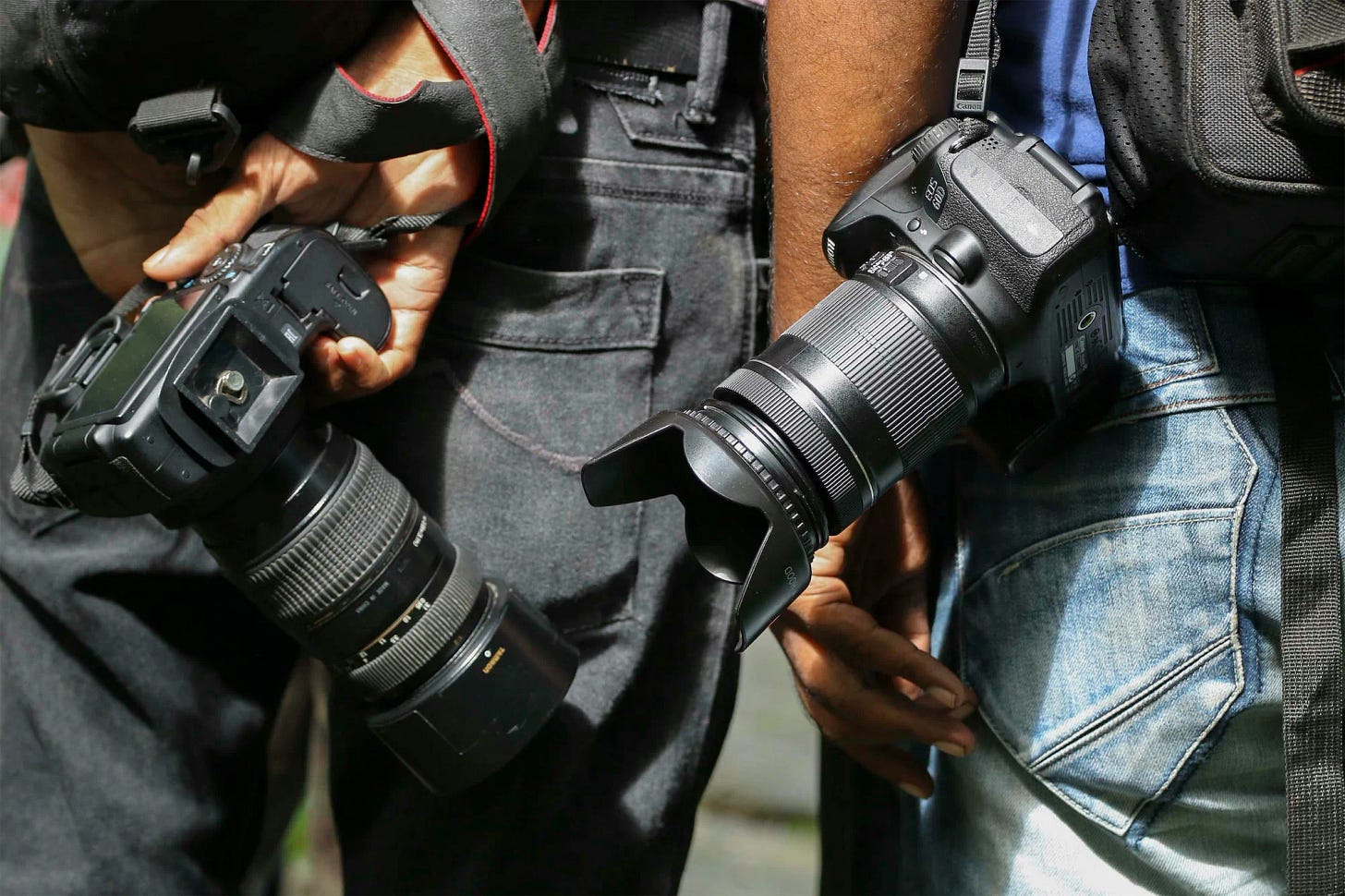
Sometimes the hype machine captures us thanks to social comparison syndrome. We see other people’s kit and it fuels discontent with our own. It’s usually perfectly innocuous – but it happens.
You see a friend out and about on a morning shoot and as you catch-up the friend shows off their new camera, lens, tripod or camera bag. And seeing that shiny new bauble in real life, being used by a mate, is a far more compelling marketing effect than any expensive advert, magazine review or YouTube video.
The Self Preservation Society
Ultimately, unless you are a member of the aforementioned ‘comfortably off’ brigade, it comes down to a choice between creativity and consumption. Are you making images or just collecting kit?
It’s about reclaiming control, finding fulfilment, and using what you’ve already got to the best of your abilities. And that last bit – to the best of your abilities – is an under-rated concept I reckon. Sometimes we upgrade because of a gap in our skillset, not because our gear is not up to the job.
For example – before I moved to Fujifilm, I was a Canon user – and my last Canon camera was a 7D Mark II. I got a lot of hard use out of that camera, but there were some things I wished it had, such as a more flexible bracketing system.
I shoot at sunrise and sunset on a very regular basis and shoot bracketed to capture the full dynamic range of the light. But it bugged me that I was restricted to a maximum of 3 frames per bracket. It also bugged me that it didn’t have focus bracketing and I had to do my focus shots manually – readjusting the focus reticle on each shot.

The irony is that since I got my Fujifilm X-T4, which has all manner of exotic bracketing modes – I still focus bracket manually. That’s partly because the Fuji focus bracket system is clunky as fuck, but partly because I just get better results doing it myself. It’s a bit like driving a car with a manual gearbox instead of an automatic – *you* have full control, *not* some electronic system.
In this way, I realised that limitations are actually a superpower – being forced to work with a system means you need to get creative. And in turn, that creativity makes you sharper and more inventive.
Mastering the gear you already own is a surprisingly radical concept. Taking the time to understand all of the camera, not just the obvious bits. For example, being restricted to specific lenses means you have to get creative with how you use them – and I reckon that nothing symbolises that better than the Brenizer effect.
Back in the mid-200s, Ryan Brenizer wanted to mimic the look of large-format photography – specifically the shallow depth of field and the wide field of view. And since he didn’t have access to a large format camera or the desire to lug one of those beasts around – he decided to fake it with his DSLR.

By shooting a series of overlapping images with a fast prime lens and then stitching them all together he could simulate the large format look you get on something like an 8×10 film camera using an ordinary everyday DSLR. He was quoted in interviews as saying that it was a workaround for equipment limitations, but also a way to push the creative boundaries and make unique images on digital equipment.
Necessity, as the saying goes, is the mother of invention.
The Psychology of Enough
Let’s face it, learning to be content with what you have is harder than clicking ‘Buy Now’, but as I hope I’ve shown, it can also more rewarding. In the modern world, where we are constantly, endlessly being pitched to in myriad blindingly obvious and also in precise covert and cruelly scientific ways, not buying is a small act of defiance.
Thor-only knows, I’m not against getting new gear – truthfully, I love everything about it.
The research phase, the shortlist, the chosen vendor, the anticipation before arrival, the arrival, the unboxing, that new gear smell, peeling the protective film off, the ceremonial jettisoning of the manual, the first test – let face it, it’s a quasi-religious experience.
But remember this – that whole process is part of the marketing too – it just happens to take place a bit further down the supply chain than the sponsored videos, the product placement on TV, the rebadged sports arenas, the billboards, the branded clothing, the satisfying clunk of a magnetic clasp and the tiny sachets of desiccant pretending to care about your consumer experience — all of it, every last shred, is theatre. And you’re not just the audience. You’re the mark.
There is genuine power in being happy with what you’ve got, because serenity doesn’t come with a coupon code or affiliate links.
Also published in RAW & Unfiltered on Substack.