The Unfortunate ‘Enhancement’ Dilemma in Photography
And why astrophotography is the biggest offender
I
belong to a Facebook group for people who are interested in viewing and/or photographing the Aurora Australis; and as you might imagine, that group’s been a busy place over the last few days thanks to a strong magnetic storm and excellent Aurora forecasts for latitudes quite far north in Australia. Sidenote: we’re talking Aurora Australis – not Aurora Borealis and therefore further south is better.
And I was having my allotted 30 second browse of Facebook for the day (because who can honestly stomach any more than that?) and this post came up.
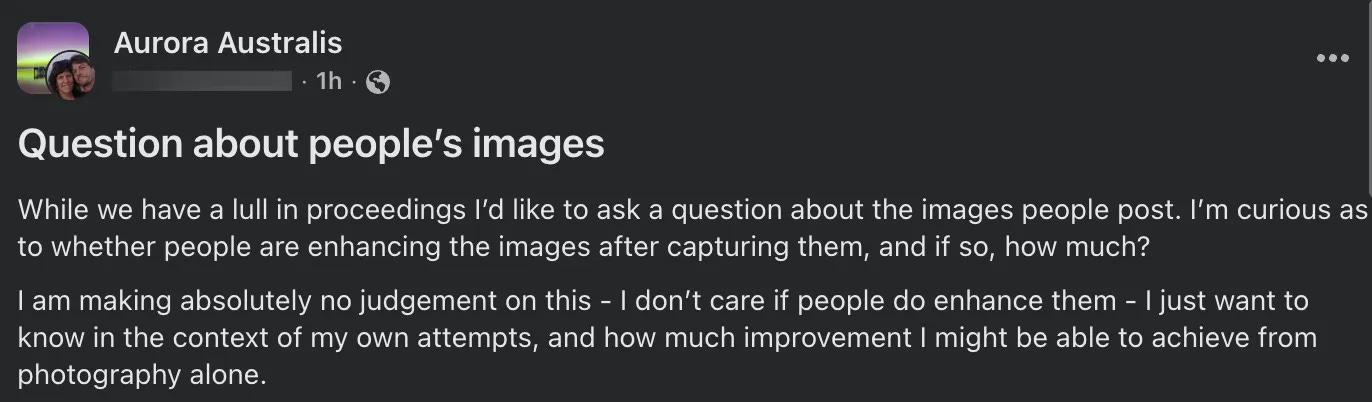
Like me, this lady had been seeing all of the photographs popping up in the feed and had noticed that the levels of saturation and contrast varied enormously from photograph to photograph. And she asked, quite reasonably, how much people were ‘enhancing’ their photographs.
There were a lot of replies to this post, but one of the most common responses was from people photographing the scene with a smartphone and claiming that their photos were unedited and unenhanced.
This raises an interesting point, that ties into commentary I’ve made in my videos on my YouTube channel about how Apple’s decision to put a camera in the original iPhone changed photography forever. Because the people posting those iPhone or Samsung photos of the Aurora might take photographs, but they are definitely not photographers.
And I don’t say that in a mean or condescending way.
Simply owning a device that takes photographs does not make you a photographer. Instead it’s an active decision you make one day – you decide to be a photographer. There’s no entrance exam, no joining fee and no contract to sign, but you have to make the decision. And when you make that decision you begin learning all the technical, compositional and artistic stuff that goes along with this highly technical hobby.
We photographers fully understand that even a digital photograph ‘straight out of camera’ is not unedited – its binary data has been squirted through a highly technical pipeline inside the camera. The way the sensor works, the size of the sensor, the design of the camera body, the lens, the electronics inside the camera body and lens – all of those contribute to how a photograph looks. The manufacturer edited the photograph even before you see it on the back of the camera.
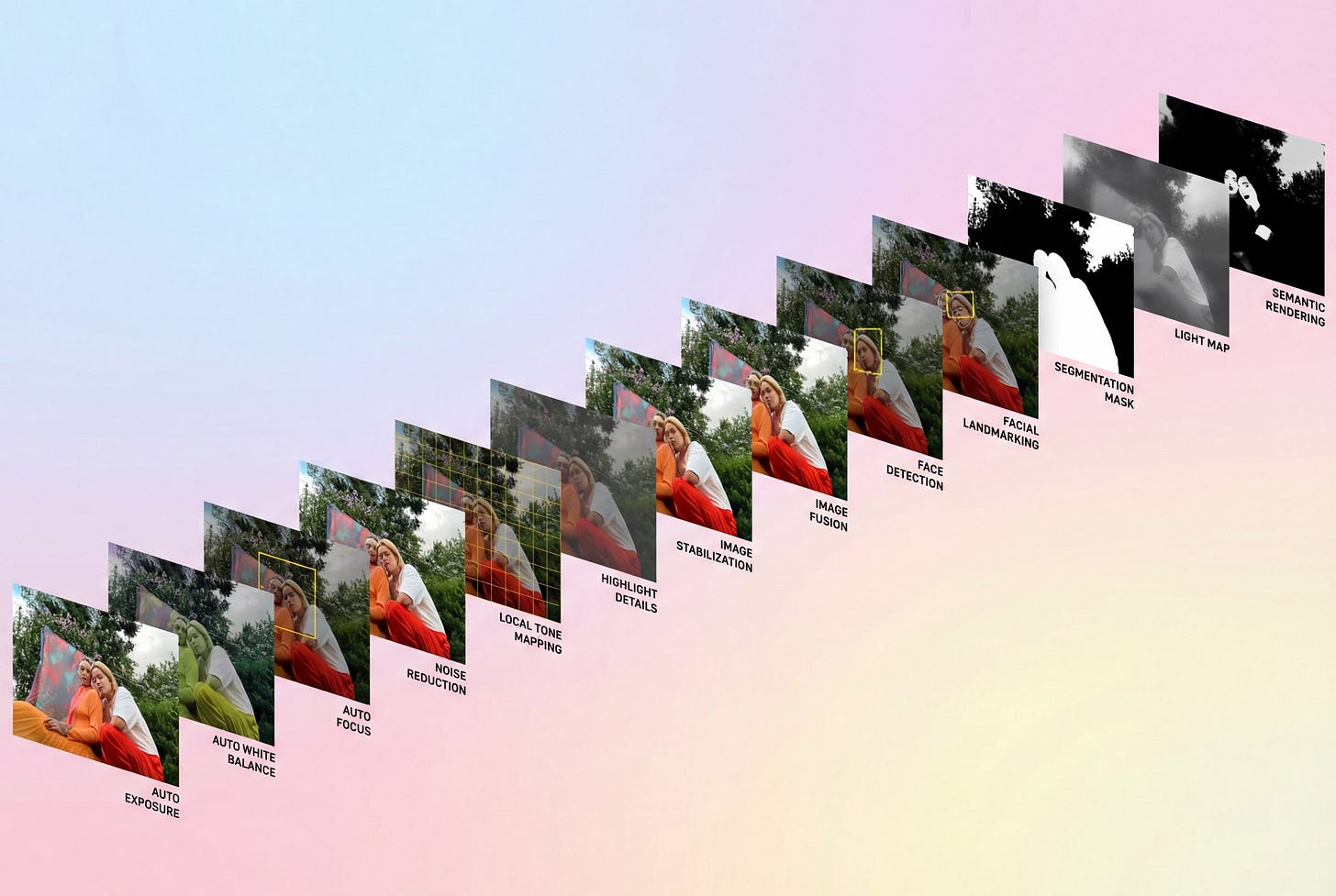
But the phrase ‘computational photography’ has not entered the lexicon of the average smartphone user. They seem to think that rooms are magically lit by some unseen light-source and that when they take a photograph in a dark pub or restaurant, they’re just capturing it. Never mind the 18 separate processing steps, or the fact that the single photo they thought they took is actually a cleverly stacked combination of three or more exposures.
And that’s why, when asked if they’d edited their photos they proudly said that they had not. They weren’t lying, but I think we can all agree that those photos are so far removed from being a visually accurate record of the scene as to make a Renaissance portrait painter say ‘steady on, mate’.
Here’s a diagram showing the computational photographic pipeline that Apple use every single time you press the shutter. This is for regular photos – if your phone’s in night-mode then there are further steps to increase light levels and bump up saturation. As you can see there’s nothing ‘straight’ about it – the phone is doing a heap of heavy-lifting for you to bring you a greatly enhanced version of the scene you can see with your own eyes.
However the worst that you can say about the smartphone shooters is that they’re naive. It’s a different matter when it comes to photographers using digital cameras such as a DSLR or a mirrorless. We work with RAW files.
RAW photos are literally just a data-dump of all the information a regular camera captured at the time of exposure. In that sense, before it is edited, it is a far truer representation of the scene than a smartphone photo.
However, RAW files are not meant to be presented ‘as is’ – they were originally created as the digital equivalent of a film negative and have a very flat colour profile that was always meant to be edited.
The extent to which any photographer edits their photographs is largely up to them – it’s their shot and if they wish to make the photo look more saturated than it was in real life, then that is their choice. It is possible to edit RAW files and keep it looking the right side of ‘natural’ but it’s their photo and they can do what the fuck they want with it.
But it seems to me that when it comes to astrophotography, and I think this is actually quite unique to astrophotography, all restraint is not so much thrown out of the window as catapulted into the sun. Which is why the lady in the Facebook post, after viewing several hundred aurora shots, looking a deeper more vibrant purple than Prince’s feather boa, wondered if they were being enhanced.
The answer is, of course, yes – they are most definitely heavily edited. In many cases they will be composite shots comprised of perhaps a couple of exposures, but often many, many more. They will all have gone through a serious round of editing in something like Adobe Lightroom and they will have travelled a long way from the look of that original neutral-looking RAW file.
And I’m not taking the moral high-ground here either, I’m as complicit in this deceit as everyone else. I’ve stacked my milky way shots, I’ve exposure blended my blood moons and I’ve sharpened the fuck out of my meteor showers. But over the years I’ve found myself increasingly ill at ease with these edits and it’s my strong belief now that most modern astrophotography has all the photographic validity of a computer render.
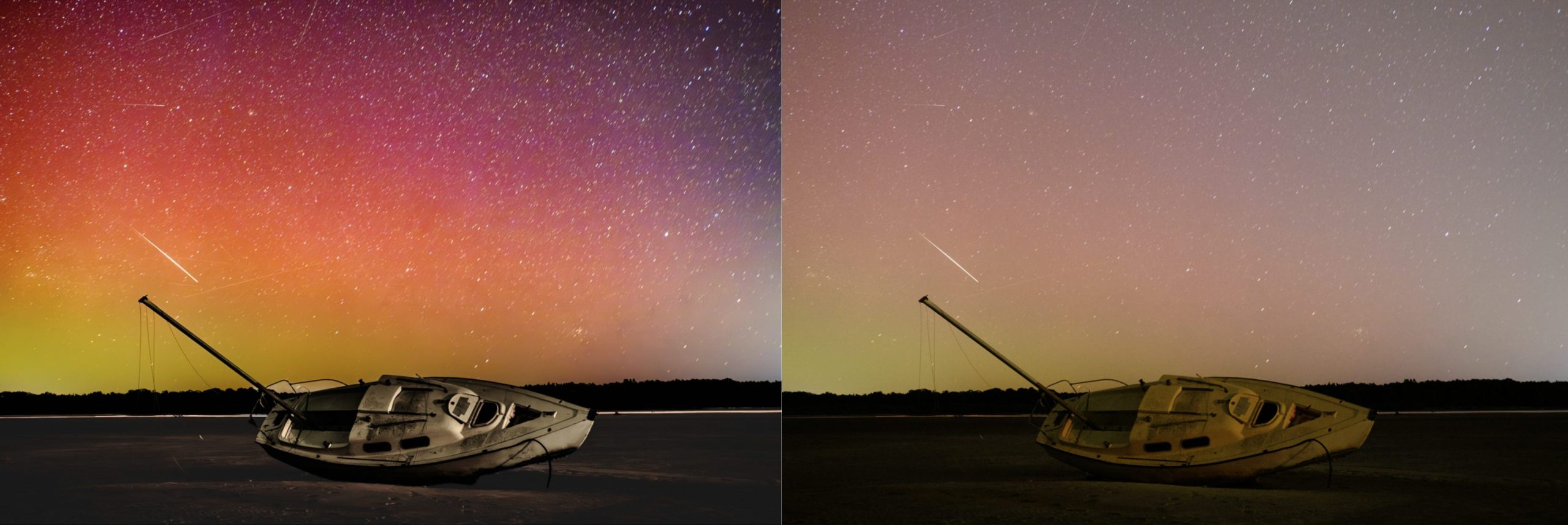
I’ve included one of my edits in this article and you can see for yourself what the original RAW file looked like and what I ended up with. They look very differently obviously but it’s the sky that shows the most dramatic transformation. What might surprise you is that actually this is a really light edit – mainly using localised masks to fix a few colour issues.
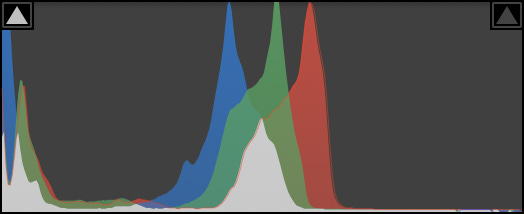
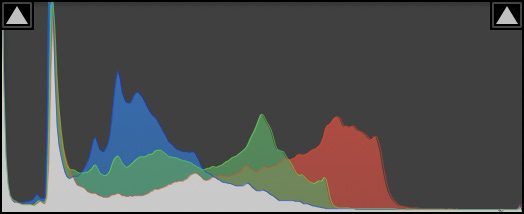
The main reason the edited photograph looks so much more vibrant than the RAW is that I fixed the white and black points. You can see the original histogram below and the edited image’s histogram below it. Apart from the denoise there are no global edits to the image at all. For the sky I bumped clarity by 30% and used a 50% dehaze to shift that atmospheric haze you can in the RAW.
So that’s my edit, and I’d argue it’s on the conservative end of the spectrum. But if you scroll through that Facebook group, or any astrophotography feed for that matter, you’ll see shots that make mine look like I forgot to take the lens cap off. We’re talking skies so purple they’d make Cadbury’s legal team nervous, Milky Ways with more pop than a K-pop concert, and auroras that appear to be powered by a nuclear reactor just out of frame. The lady who asked the original question wasn’t imagining things.
The question that arises out of all this is why we’ve ended up in a situation where restraint and reality are abandoned – and I lay the blame squarely at the door of social media.
Most photographers take photographs to share on platforms like Facebook or Instagram for clout and likes and those photographs with heavy saturation, massive contrast levels and extreme sharpening serve as better eye-candy in a doom-scroll than the more naturally edited shots and so they process their images in such a way as to get noticed by the algorithm.
So I think photographers need to ask themselves who they are taking these photographs for? If they’re for their own enjoyment and perhaps to print out and put on the wall in their own home then can and should process them in any way you see fit. But if they’re taking them to get likes then the only ‘improvement’ they need to make is to lean on the right-hand side of all the sliders in their RAW editor because that’s how the vast majority of these shots are ‘enhanced’ – heavy saturation, exposure blending, strong contrast, layered masking, vignetting and brush work to dodge and burn.
Also published in RAW & Unfiltered on Substack.