A
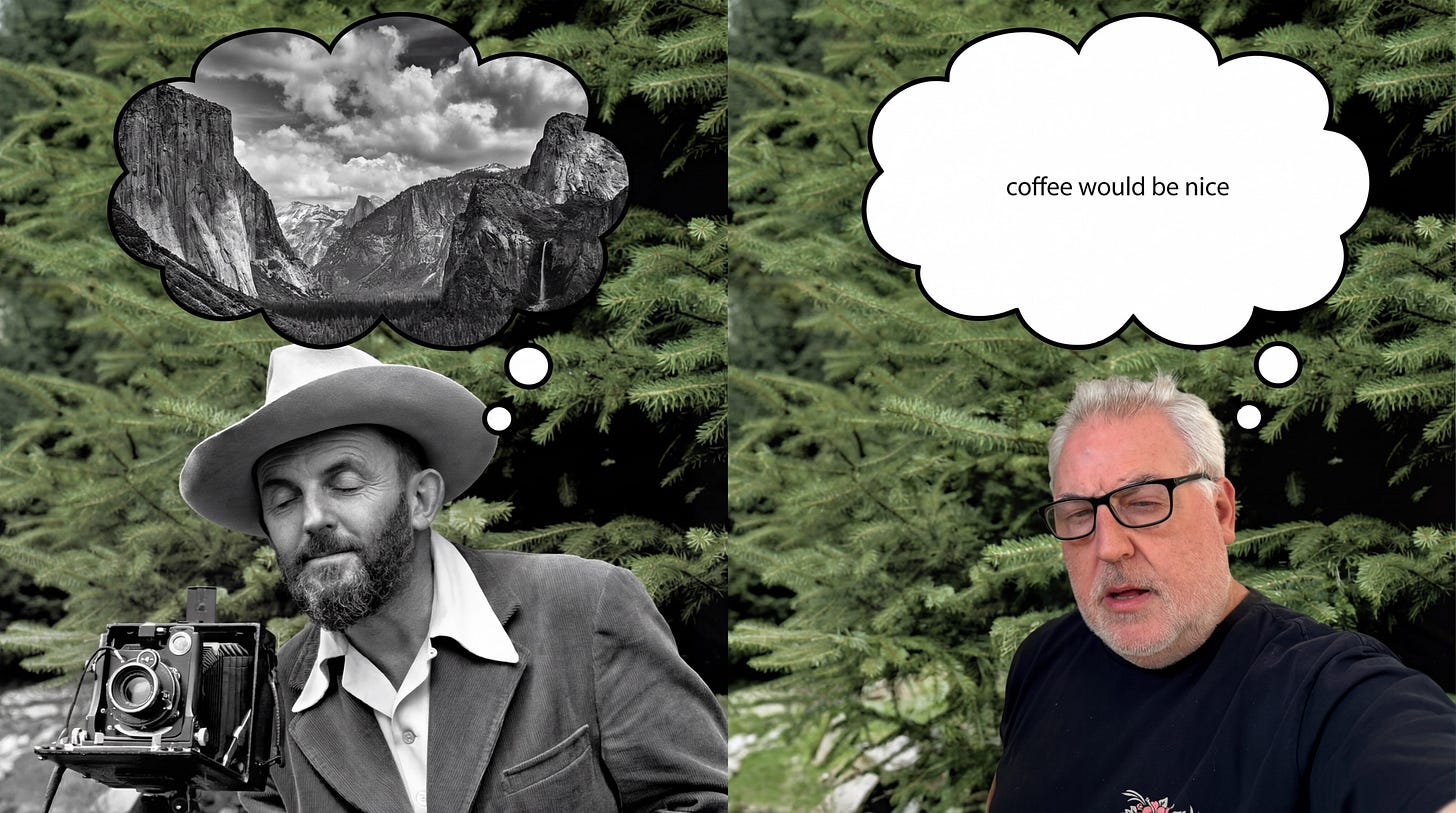
nsel Adams, probably the most famous landscape photographer of all time, popularised the concept of pre-visualisation in the late 1930s: the idea that you should ‘see’ the finished image in your mind before you press the shutter. The method teaches us to visualise how the finished photo (or print in Adams’ case) will look, then work backwards to determine exposure and development or post-processing. You’ll have heard the phrase a thousand times and no doubt seen many videos and articles explaining why pre-visualisation is a powerful tool.
But what if your mind’s eye is permanently closed for business? What if, when you’re asked to close your eyes and imagine a scene, you ‘see’ absolutely nothing?
I’ve never visualised a photograph in my life. Let me tell you how I do it anyway.
The Apple Test
I’d like you to try something for me. Close your eyes and imagine an apple. Rate what you see: is it vivid and detailed like a photograph? Or is it vague and fuzzy? Do you see just a dim shape? Or do you see nothing at all, just this vague concept of an apple with no visual component whatsoever?
Or how about this one. Close your eyes and picture the face of someone close to you. Can you see their eye colour? The shape of their nose? The specific way they smile? Or do you just know facts about their face without seeing it?
I have a condition called aphantasia, which means when I try to imagine something in my mind, I come up completely blank. It’s not a dark void, like peering over the event horizon of a black hole, I just don’t see anything. There’s no slideshow going on in my mind, no personal cinema. When I try and picture the face of my wife I get only the ‘concept’ of her, a keyword and a few hashtags if you like, not some neuron-powered polaroid.

Aphantasia was first documented back in 1880 by a bloke called Francis Galton. He surveyed people about their mental imagery and found significant variation, including people who reported none at all. But it wasn’t until 2015 when Professor Adam Zeman of the University of Exeter gave it a name, after a patient of his lost his ability to visualise following heart surgery. Media coverage of that case prompted thousands of people to contact Zeman saying ‘hold on, that’s me, but I’ve always been like this.’ Turns out roughly 2-5% of the population had been quietly getting on with life, assuming everyone else was speaking metaphorically when they said ‘picture this’. And I’m in that 2-5%.
Sidenote: I’ve also had ‘white noise’ style tinnitus my entire life, but because I never compared notes with anyone I didn’t realise that not hearing a constant high-pitched noise even when everything is ‘silent’ is more typical. In fact I only found out by accident, about five years ago during some random discussion with my long-suffering wife, Catherine.
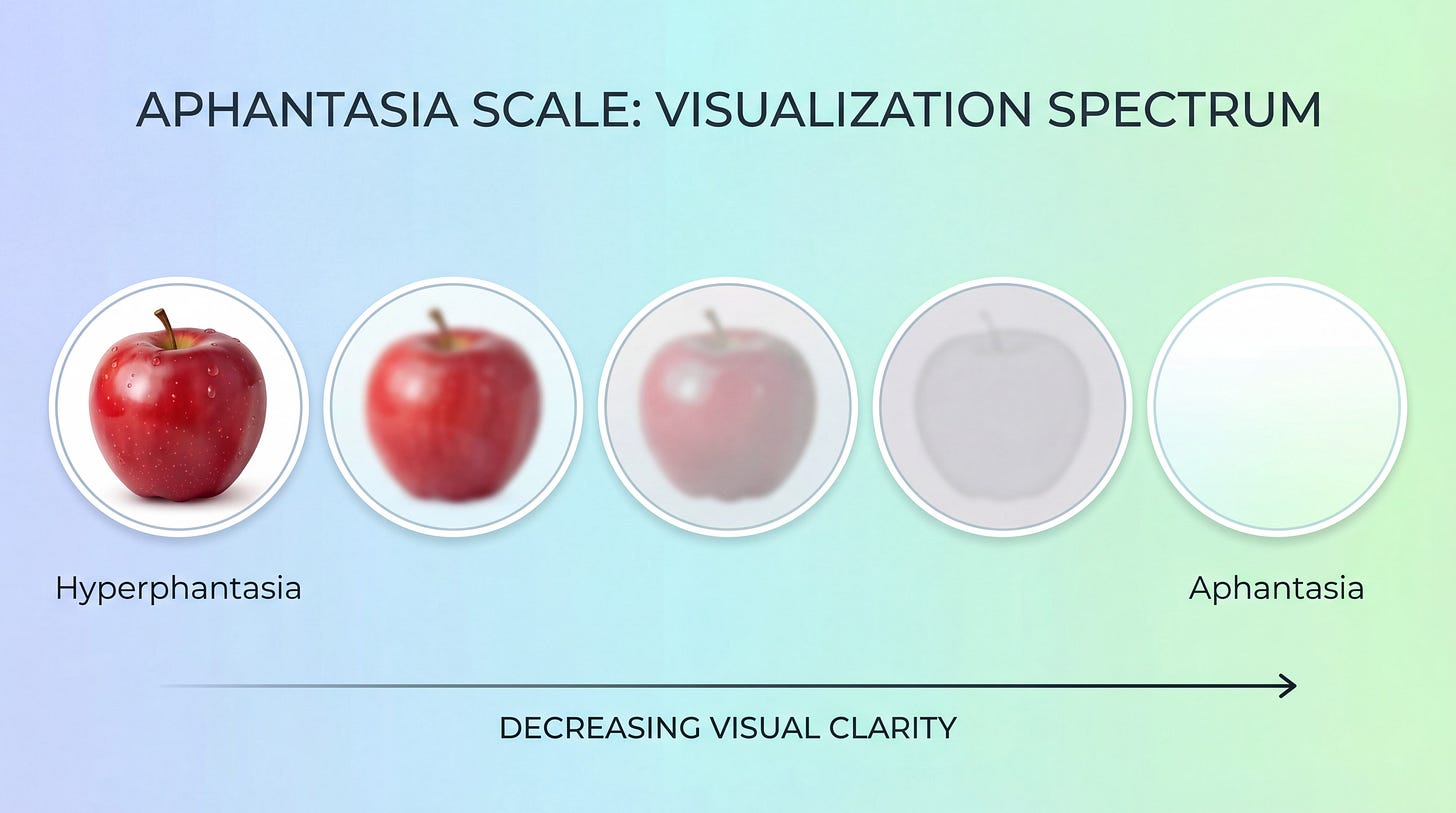
Now, like so many conditions of the brain, aphantasia isn’t a binary condition, an either on or off kind of deal. Instead, it’s like autism: it presents on a scale. The spectrum runs all the way from hyperphantasia to complete aphantasia. The former being vivid, controllable mental imagery (and not a live action remake of that Disney film that looked like the animators were on acid), and the latter being no voluntary mental imagery at all.
Recognition and visualisation are not the same thing
So by now you may be saying to yourself: hold on Andy, if you can’t visualise imagery in your brain, how the fuck do you recognise places in photographs?
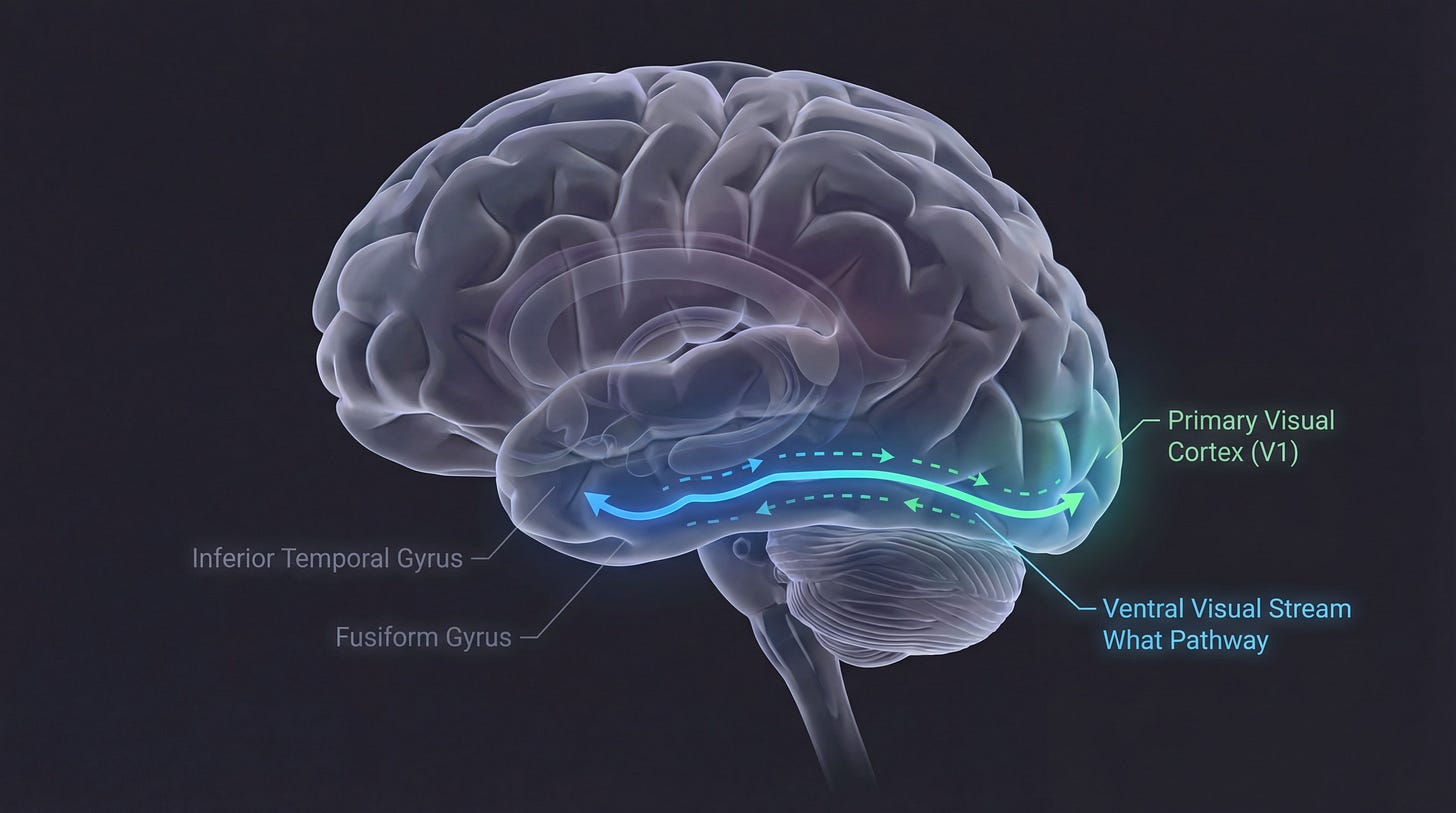
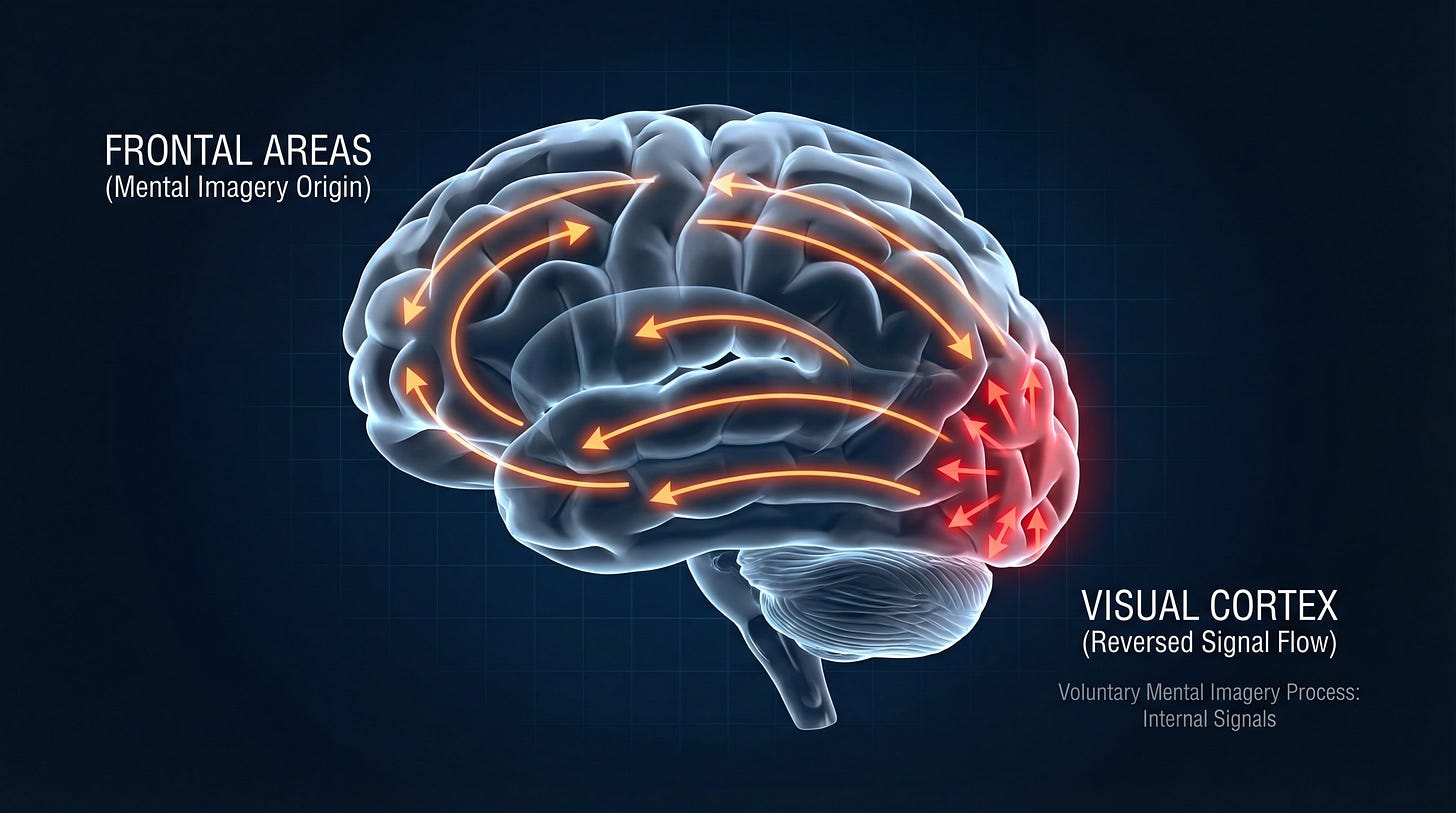
And that, my friends, is because recognition uses the ventral visual stream (the “what” pathway in your noggin, if you like), while voluntary mental imagery uses different neural networks, specifically, the visual cortex working in reverse. Recognition and visualisation are entirely different systems. A bit like how recognising your long-suffering wife in a crowd and drawing her from memory are completely different skills. One I can do without thinking. The other would likely get me divorced.
So no, I don’t find myself standing on some random beach, scratching my head and going ‘where the fuck am I?’ At least not because of the aphantasia, if you know what I mean.
And actually, having aphantasia means I’m probably much better at recognising locations than someone who is unaffected, because I have to rely on spatial memory instead of visuals. In effect I kind of store places as data, not pictures. It’s less photo album, more GIS. Geometric relationships and orientation rules. I recognise a location the same way you’d identify a file by its metadata, not its thumbnail.
Sounds weird, I know, but it’s also pretty cool I reckon. Bit like when Neo sees the actual matrix for the first time and it’s this waterfall of data and not the virtual reality that the normies are getting.
It also explains why I tend to glaze over and enter a catatonic state when some seasoned photographer, out on location in the Peak District or Utah, says “I visualised exactly this composition driving up here.” Cool story mate. I visualised a coffee and a wee.
A feature, not a bug
The big question, of course, is how I get around this neurological curveball. Surely being a photographer and not being able to visualise a scene is like being a soccer player who’s goal blind? Insert your own gag about West Ham in there.
And the answer to that question, surprisingly, is that it’s probably been more of a benefit than a flaw over the years.
You see, I have to base all my what-ifs on knowledge and experience, not some whimsical fantasy that I think up while I’m day-dreaming on the shitter. It’s all well and good visualising the fog hanging like gossamer over a stunning lake with water so tranquil it’s like glass, but nobody visualises the flies or the school party practicing eskimo rolls in their canoes.
Studies by Zeman and others have found that people with aphantasia are less susceptible to certain types of false memory formation, probably because we’re not accidentally contaminating our recall with imagined details. We tend to have more accurate recall of factual information precisely because we’re not reconstructing scenes from fuzzy mental pictures.
If you are someone who doesn’t have aphantasia you might remember a scene being more dramatic than it was, or you might conflate multiple locations into one imagined composite. And ermm, I can’t do that. What I know about a place is what I actually observed, stored as facts and spatial relationships, not a degraded JPEG that gets more compressed every time I access it.
If you think about it, pre-visualisation has as many flaws as advantages. You’re generating an image that doesn’t exist yet, based on conditions you’re guessing at, then comparing reality to your fantasy when you arrive. That’s a lot of cognitive overhead, and a lot of opportunity for disappointment when the world doesn’t match your imagination. I skip that entire step. I’m not disappointed that the light isn’t what I pictured, because I didn’t picture anything. I just respond to what’s actually there.
When I take a photo and look at it on the LCD I just make critical assessments about the shot I took because no mental comparison image exists. And when I get home and import the photos into Lightroom, I’m not pushing the narrative of the photo in the direction of some imagined shot I never quite managed to pull off, I’m just bringing out the best in the photo I’ve actually got in front of me.
Of course, if we take this logic to its natural conclusion, Ansel Adams essentially established the concept of bullshitting your way to a good photograph and led to the mainstream acceptance of making stuff up and calling it technique.
But what do I know? I’m just a charlatan hobbyist photographer who likes photographing sunsets, not the dude who shot super-high contrast black and white photos at tourist lookouts in Californian national parks.
When I go out with my camera into the natural landscape, I’m never disappointed that reality didn’t match my imagination (because there was no imagination to disappoint). Arguably I’m more present, more responsive to what’s actually in front of me rather than chasing some idealised mental picture, forcing the scene to be something it isn’t.
If there’s one big takeaway from this it’s that photography is fundamentally an external medium: light recorded by a sensor, displayed on a screen or printed out. The entire process can function without internal imagery. You don’t have to magic a scene into existence. Instead you can just shoot the one you actually find.
The assumption that you need to visualise is just that: an assumption. Ansel Adams built a whole philosophy around it because it worked for him. It doesn’t work for me. So I built my own. And if you’re sitting there thinking ‘hang on, I can’t visualise a fucking thing either’, welcome to the club. You’re not broken. You’re just paying attention to what’s actually there instead of what you imagined. That’s not a limitation. That’s a head start.
If the technique police come for me, tell them I was too busy actually taking photos to notice.
Addendum: since I shared this article on my YouTube channel, a couple of folks have pointed out that what Adams referred to as pre-visualisation was more about creating a post-processing darkroom storyboard for a photograph he’d already taken, than picturing a scene before taking it. What is also clear is that whatever Adams originally meant when he popularised the term, it has evolved over the last 100 years to mean something completely different in the 21st century.
I suspect a lot of the confusion arises from this quote:
I go out into the world with my camera and come across something that excites me emotionally, spiritually or aesthetically. I see the image in my mind’s eye. I make the photograph and print it as the equivalent of what I saw and felt.
Perhaps we all paid too much attention to the middle sentence “I see the image in my mind’s eye” and not enough to the last one.
Over the years the term has clearly changed and I suspect the majority of photographers understand it to mean picturing a scene a certain way in your head and then going out and trying to photograph it.
And having looked into this further, it turns out that the shift in definition began with a photographer called Minor White who, in the 1960s, divided photography into pre-visualisation (while studying the subject) and post-visualisation (printing it).
Then of course digital photography came along and any need for darkroom notes went out the window because we could do whatever the hell we wanted with the photograph in our RAW editor of choice. And so the technical grounding that gave Adams’ version its meaning evaporated.
There’s a very interesting article written by Mike Shipman in 2010 called Visualization, Pre-Visualization, and Post-Visualization in which he says the following:
Pre-visualization can be a negative barrier to the art/landscape/travel photographer. Pre-visualization to this group of photographers might be a set of expectations regarding weather conditions, access to subjects, etc. When pre-formed expectations are not met by existing conditions (rain instead of sunshine, or the medieval cathedral is under renovation and surrounded by scaffolding, for example) it can be a frustration leading to the shutting down of awareness and receptivity, thus blocking the photographer’s ability to photograph or even be aware of other opportunities. A photographer acquaintance once remarked how a trip to Australia was a “waste” because the conditions were not as he expected them (pre-visualized) so there “was nothing to shoot.
Mike Shipman Visualization, Pre-Visualization, and Post-Visualization – 2010
Then there’s this article by Ben Hall from 2024 which codifies the modern definition of pre-visualisation. And he says:
Pre-visualisation is the process of imagining and planning your photographs before you even step into the field. It involves envisioning the final image you intend to create and considering in advance the elements that will complete your scene.
Ben Hall – The Importance of Pre-visualisation in Photography – 2024
So there you go. Turns out that the term pre-visualisation has definitely evolved over the years to mean something completely different to the way Ansel Adams used it. So if you’ve been struggling to imagine scenes, as defined by award-winning photographers like Ben Hall, then you probably have aphantasia too.
Also published in RAW & Unfiltered on Substack.